- Born: March 14, 1716, Lampertheim, Germany
- Parents: Hanß Philipp Wegerle and Barbara Keßler
- Relationship: My sixth great-grandaunt
Euphrosina Wilhelmina Wegerle was my sixth great-grandaunt and a member of the German generation of the family that lived in Lampertheim before my direct ancestors came to America. She was born on March 14, 1716, in Lampertheim, more than sixteen years after her older brother Johann Paul Wegerle, my sixth great-grandfather, was born.
Her parents were Hanß Philipp Wegerle and Barbara Keßler, whose marriage is recorded in Lampertheim on June 19, 1691. The same couple was the parents of Johann Paul Wegerle, born May 10, 1699, whose family would eventually leave Germany for Pennsylvania in 1732.
The quest to unravel Euphrosina’s life led me down a path filled with linguistic nuances and historical discrepancies. Variations of her last name in German records, including Waegerle, Wegerle, Wageli, and Wägeli, among others, show the fluidity of language and naming conventions over time.
- Wegerlin
- Wegelin
- Wägerlin
- Wegerlein
- Wägele
- Wägeli
- Waegerlen
- Waegerlin
- Weckherlin
- Weekerlin
- Wegerle
- Weggerly
- Weikhelin
- Wiegerlin
- Wigerli
- Wigerlin
- Waeckherlin
- Wuekherlin
A notable aspect of this journey was understanding the pronunciation of ‘Wägeli.’ A consultation with a German translator revealed the intricacies of phonetic translation, approximating ‘wu-ghe-ly’ as the closest pronunciation for an English speaker, albeit not entirely accurate.
A Daughter of the Wegerle Family in Lampertheim
Euphrosina was born into a family whose surname appears in historical records under numerous spellings. Forms associated with this extended family and related records.
Those differences should not automatically be interpreted as different families. Early German records were created by different ministers, clerks, and later transcribers, and spelling was not standardized as modern researchers expect.
For this branch of the family, I currently use Wegerle as the principal spelling. Records associated with Hanß Philipp and German records connected with Johann Paul support this form, although other versions continued to appear throughout the family’s history. I previously used the name “Wägeli” for the earlier branches of the family, but since her father has so many documented records with the last name Wegerle, we’ll stick with that.
Her Unusual Name
Euphrosina’s given name is one of the most distinctive in my family tree. Variations such as Euphrosina, Euphrosyne, and similar forms appear in German records, while Wilhelmina can likewise appear as Wilhelmine.
To me, the name is unique, and I love it. But as it turns out, back then in Germany it wasn’t uncommon. It only became rare after they left Germany and came to the United States.
The unusual name later contributed to one of the more complicated mistakes in my genealogical research. I found another woman with an almost identical name and initially believed I had discovered Euphrosina’s marriage and children. I had not.
The Ludwig Gottlieb Sieber Mistake
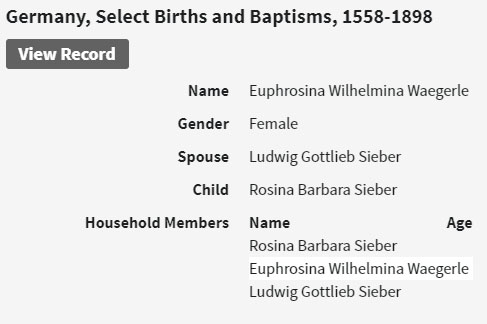
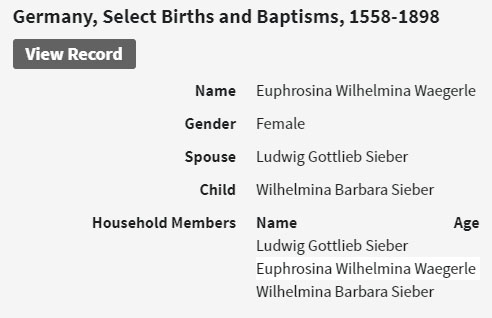
The collection Germany, Select Births and Baptisms, 1558-1898 contains records identifying a woman named Euphrosina Wilhelmina Waegerle as Ludwig Gottlieb Sieber’s wife. The couple was associated with daughters including Wilhelmina Barbara Sieber, born in 1858, and Rosina Barbara Sieber, born in 1859.
At first glance, the names appeared to fit remarkably well. The surname was another recognizable variation of Wegerle, and the woman’s unusual combination of Euphrosina and Wilhelmina seemed too distinctive to be a coincidence.
For a time, I attached these records to the Euphrosina born in 1716.
The problem became obvious once I examined the dates together. If the 1716 Euphrosina had given birth to Rosina Barbara in 1859, she would have been approximately 143 years old. Clearly, these could not be the same woman.
A Second Euphrosyne Wilhelmine Waegerle
Further research revealed the actual explanation. Another woman named Euphrosyne Wilhelmine Waegerle was born on August 6, 1819, more than a century after my ancestor’s sister.
The later Euphrosyne was a daughter of:
- Johann Christian Waegerle
- Rosine Catharine Enderle
She married Ludwig Gottlieb Sieber. The Sieber daughters born during the 1850s therefore belong to this nineteenth-century woman, not to Euphrosina Wilhelmina Wegerle of Lampertheim born in 1716.
The similarity between the two women’s names was extraordinary, but genealogy cannot be established through names alone. Dates, parents, locations, spouses, and generations must all fit together.
The marriage of Hans Philip Wegerle and Barbara Keßler in 1691 in Lampertheim provides a documented connection to the Wegerle family. But the mystery around Euphrosina’s life and lineage persists, underscoring the complexities and surprises inherent in genealogical research.
PLEASE NOTE: I am taking you on a research journey to show you how things you are sure are true later turn out not to be. Please read this document all the way through before confirming any facts in your family tree. At the bottom, you’ll discover I made a mistake in my research. I am keeping it here to share how I confirmed and discredited documented “facts” from others.
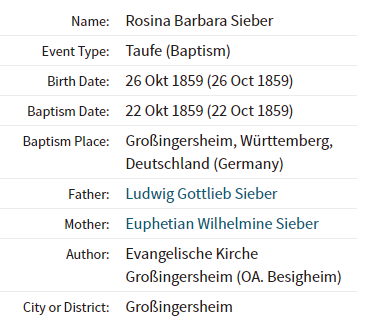
There is a record called the ‘Germany, Select Births and Baptisms, 1558-1898 (Deutschland, ausgewählte Geburten und Taufen, 1558-1898),’ and that tells us her full name is Euphrosina Wilhelmina Waegerle, that she married Ludwig Gottlieb Siber, and that they had a daughter named Rosina Barbara Sieber. Rosina was born on October 26, 1859.
 Another similar document shows they had a second daughter named Wilhelmina Barbara Sieber. She was born on May 20, 1858.
Ludwig Gottlieb F Sieber, her husband, appears to have emigrated to Russia in March of 1862. It says he was born in Grossingersheim, Germany. His children were still very young, so we can assume that his wife Euphrosina went with him, and that is where she died.
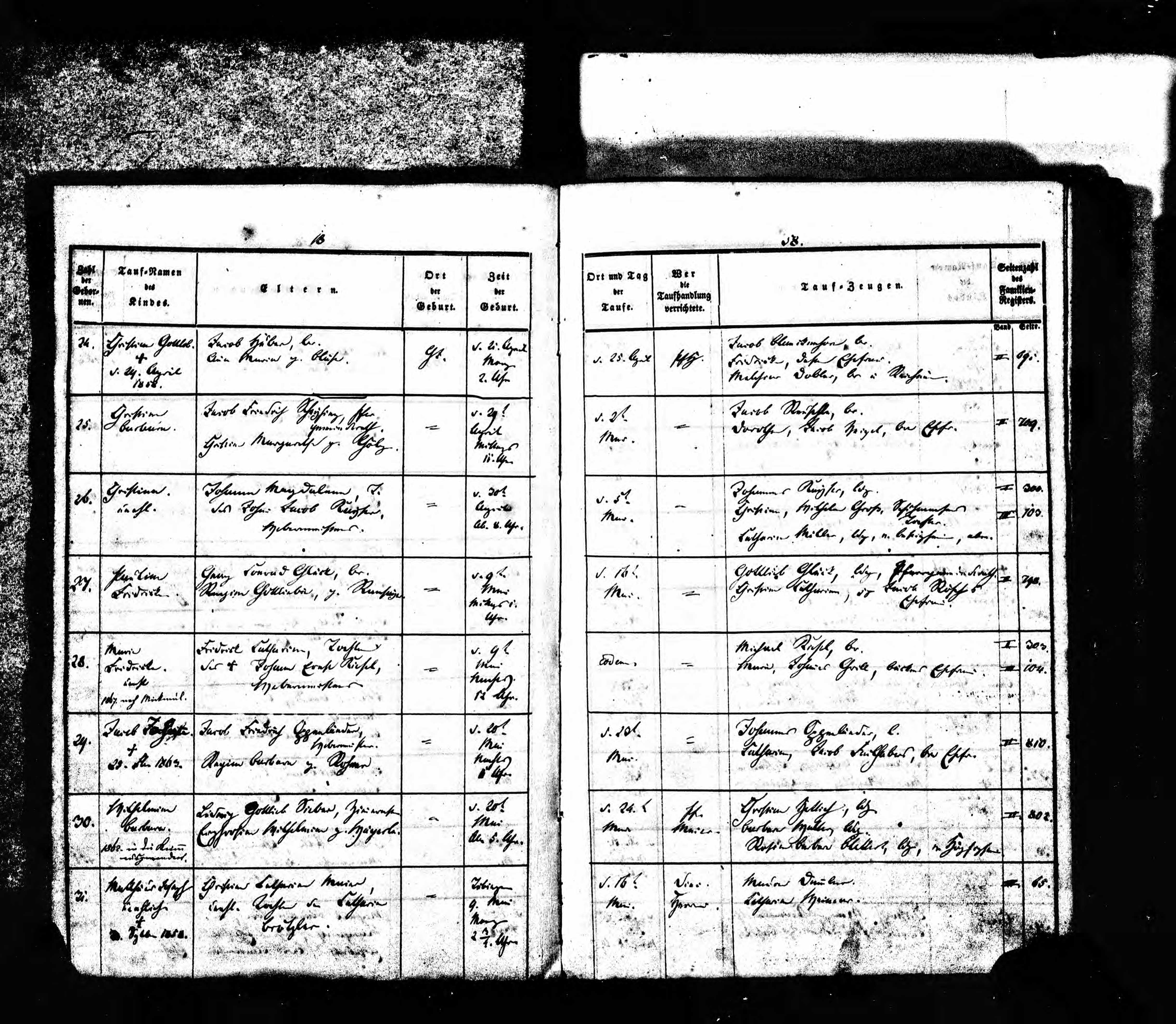
On another of Wilhelmine Barbara Sieber’s baptism records, her name is spelled “Euphemia Wilhelmine Sieber.” However, that’s very easily a translation error. As you can see in the original below, it’s hard to read.
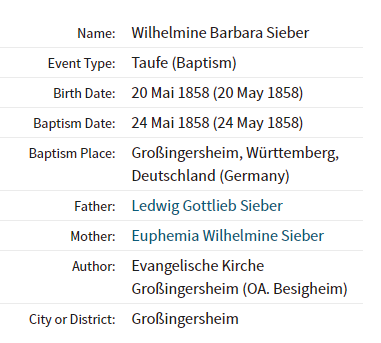
Rosina Barbara Sieber’s other baptism records also misspell Euphrosina’s name. Again, this is a common error in translation. This is why you always need multiple records to confirm the same fact, since no single source is truly definitive.
Now, we come to a stump in the road. Another one out there goes by the name Euphrosyne Wilhelmine Wagerle [Euphrosyne Wilhelmine Waegerle]. She was born on August 6, 1819, and at 37 she married Ludwig Gottlieb Siber.
However, there is a 103-year difference between our Euphrosina and this Euphrosyne. This later Euphrosyne’s parents are …
| Father: | Johann Christian Waegerle |
|---|---|
| Mother: | Rosine Catharine Enderle |
Why the Error Was So Easy to Make
This case demonstrates one of the biggest dangers in online genealogy. Once an incorrect relationship is attached to a person in a family tree, it can be copied repeatedly until hundreds of trees appear to confirm the same mistake.
In reality, those trees may all descend from one incorrect conclusion.
Surname variations made the problem even harder. Waegerle, Wegerle, Wägerle, and related spellings could all plausibly represent versions of the same German surname, while Euphrosina Wilhelmina is unusual enough that finding two women with nearly identical names seemed improbable.
The dates ultimately exposed the error.
What We Actually Know About Euphrosina
The Euphrosina in my family was born on March 14, 1716, in Lampertheim and is associated with the family of Hanß Philipp Wegerle and Barbara Keßler. She belonged to the same German family that gave birth to Johann Paul Wegerle in 1699.
Johann Paul married Ottilia in 1721 and left Germany with his wife and four children aboard the Johnson Galley in 1732. Euphrosina does not appear among the members of Johann Paul’s household who made that voyage, which is exactly what we would expect because she was his sister rather than his daughter.
What happened to Euphrosina afterward remains much less clear. I have not yet established a reliable marriage, children, death date, or place of death for the woman born in 1716.
Those blanks are preferable to attaching the wrong family to her.
What Happened to Her?
Euphrosina would have been sixteen years old when her brother Johann Paul and his family left Germany for Pennsylvania in September 1732. Whether she remained in Lampertheim, married elsewhere, moved to another German community, or died young remains unclear.
Her brother’s departure means that the two siblings’ lives may have separated permanently at that point. Johann Paul’s descendants can be traced through Pennsylvania and eventually into the Wegley family of later generations, while Euphrosina’s own path remains unfinished.
That unanswered question is now one I hope future research will resolve.
A Lesson in Genealogical Research
I have deliberately preserved the story of my mistake involving Ludwig Gottlieb Sieber because it illustrates how genealogical research actually works. Research is rarely a straight line from one correct record to another, and sometimes evidence that initially appears convincing collapses when another record is discovered.
The important thing is not making a mistake. It is being willing to revisit a conclusion when the evidence no longer supports it and to correct the family tree rather than defending an attractive story.
Euphrosina’s page is a good example of why I now place so much emphasis on dates, relationships, locations, and independent records. A matching name can begin an investigation, but it cannot finish one.
An Unfinished Story
For now, Euphrosina Wilhelmina Wegerle remains one of the more mysterious members of the early German family. We know where she belongs within the Wegerle generation of Lampertheim, but much of her adult life remains undiscovered.
Perhaps another baptismal register, marriage record, burial entry, or German church book will eventually reveal what became of her. Until then, I would rather preserve the uncertainty surrounding the real Euphrosina than give her the documented life of another woman born more than a century later.