The further back you go in your research, the harder it gets to confirm information, and even when you find it, it’s often hard to read. Johann Paul Wegerlin is the first member of my family tree, where the complications start. But I’ll do my best to provide as much documented information as possible.
- Birth: May 10, 1699 • Lampertheim, Hesse, Germany
- Death: December 7, 1763 • Warwick Township, Lancaster County, Pennsylvania
- Immigrated: September 18, 1732 • Port of Philadelphia
- Relationship: 6th great-grandfather
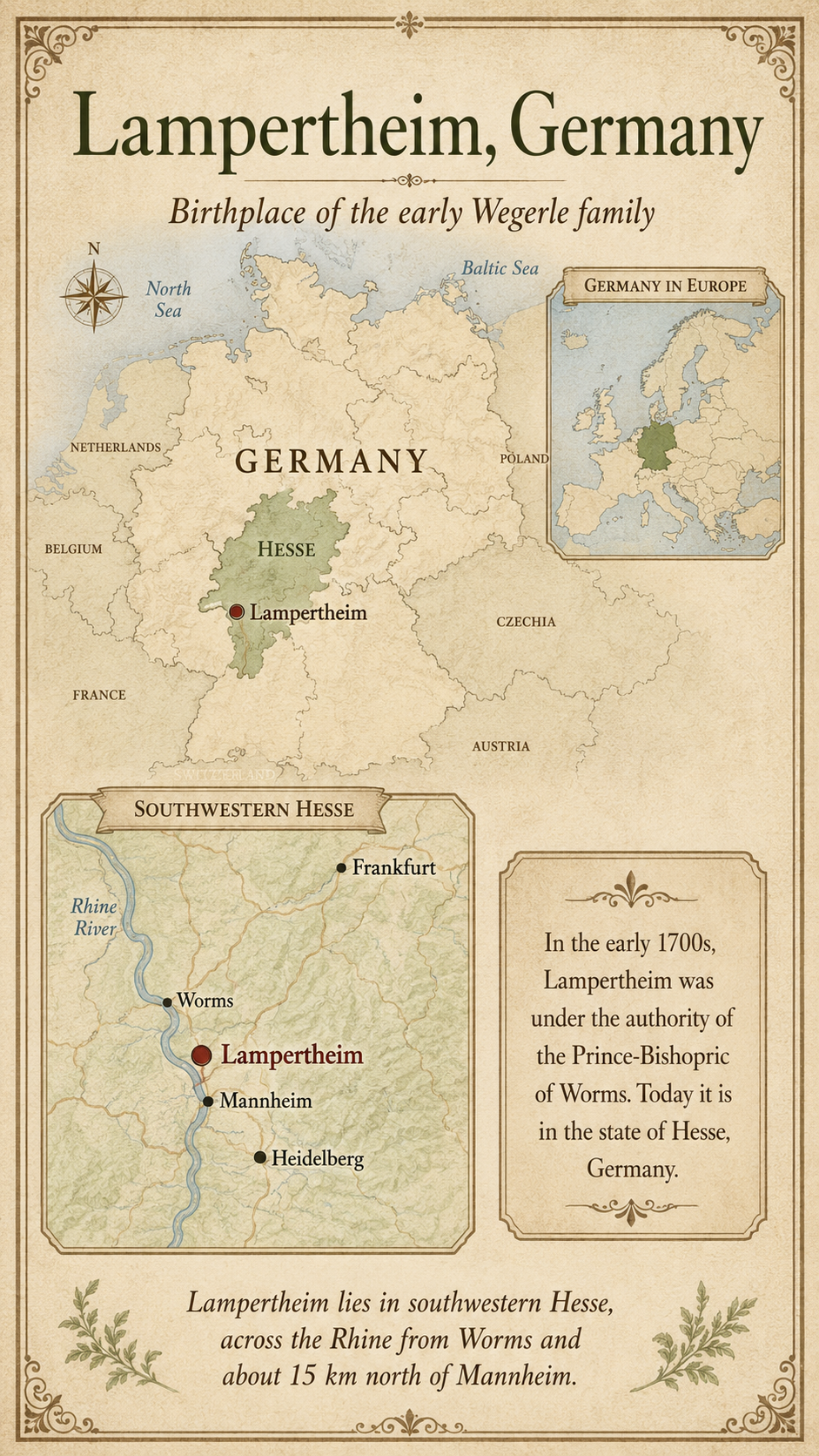
Johann Paul Wegerle is my sixth great-grandfather and the immigrant ancestor who begins the American chapter of my Wegley family. He was born on May 10, 1699, in Lampertheim, in what is now the German state of Hesse.
For years, identifying Johann correctly proved surprisingly difficult. His surname appears in records in several forms, and other German men lived during the same period with very similar names, making it easy for unrelated records to attach to the wrong family.
The first Wegley to come to the US, at least in my line, is Johann Paul Wegerlin. He is my 6th-great-grandfather and was born on May 10, 1699, in Lampertheim, Bergstraße, Hessen, Germany. When I first started this website, I was sure I knew everything I could about him. But in time I learned that just because someone else says something is true doesn’t make it so.
Is Johann Hana Paul Michael Wägeli the same as Johann Paul Wegerlin or Paulus?
That’s what I really needed to figure out. Only it’s not exactly that easy. FamilySearch hosts the German birth, death, and marriage records, and not a single image is available. The translated data is, but as we all know, it could be wrong. My question is simple … what is our real family name … not our anglicized name, but our original name? Simple enough question, right? Well, not so easy to answer.
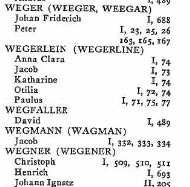
In the same batch of German records, here are the 15 common variations of our family name.
- Wegerlin
- Wegelin
- Wägerlin
- Wegerlein
- Wägele
- Wägeli
- Waegerlen
- Waegerlin
- Weckherlin
- Weekerlin
- Wegerle
- Weikhelin
- Wiegerlin
- Wigerli
- Wigerlin
- Waeckherlin
- Wuekherlin
I even went so far as to hire someone from Germany who does translations to ask him how you pronounce the name Wägeli. Was it why-gull or wu-ghel-ly or something different altogether?
He ended up telling me that the “ä” has a sound that is unique; there is no way to write it correctly for an English speaker, but if you had to sound it out like why-gull, he said the closest would be the one that you said, “wu-ghe-ly,” but it’s only close and not the right way. Here is a recording of him saying it so you can hear it in his native German tongue.)
What I can say for sure is that Johann Paul came to America, specifically the Port of Philadelphia, when he was 33 years of age, on September 18, 1732.
His Parents
Johann Paul’s parents were Hanß Philipp Wegerle and Barbara Keßler, whose surname is also commonly written Kessler in English-language records. A published transcription of Lampertheim marriage records identifies Hans Philipp Wegerle and Barbara Keßler as a married couple, with additional records giving their marriage date as June 19, 1691, in Lampertheim.
This replaces some of my much earlier research in which I considered Zacharias Wägeli as a possible father or grandfather. Based on the evidence I have now, I use Hanß Philipp Wegerle and Barbara Keßler as Johann Paul’s parents.
What Was His Real Last Name?
This question has followed my research for years because the family surname appears in an extraordinary number of forms. Wegerle, Wegerlin, Wegerline, Wägerlin, Wägeli, Waegerlin, Wegerlein, and several other variations appear in German and American records.
For a time, I believed Wägeli might have been the family’s definitive original surname. The deeper I researched the family, however, the less comfortable I became with treating any single spelling as unquestionably original.
The surviving records associated most directly with Johann and his immediate family support Wegerle as the best primary form to use today. At the same time, Johann appears as Johann Paul Wegerlin, Paulus Wegerlin, and Paul Wegerline in other records connected to his family, so those variants are not errors to be discarded.
The surname variation itself is part of the family story. Ministers, clerks, ship officials, and later genealogical indexers recorded German names differently, and standardized spelling mattered far less then than it would later.
Johann and Ottilia
On July 7, 1721, Johann married a woman whose given name most consistently appears as Ottilia. Other records render her name as Obtilia, Otella, Otelia, and similar variations, but those differences appear to refer to the same woman.
Her maiden name remains unknown.
For years, family trees identified her as Ottilia Bayer, and I once believed I had found supporting evidence in a Lancaster County will belonging to a woman of that name. Closer examination showed that the Ottilia Bayer named in that document had children named Maria Magdalena, John, and Peter, people who do not match the documented children of Johann Paul and Ottilia Wegerle.
That means the Bayer will belong to another woman. It should not be used as evidence for Johann Paul’s wife’s maiden name, so until another reliable record is discovered, I consider Ottilia’s maiden name unknown.
Their Children in Germany
Johann and Ottilia began their family before leaving Germany. At least four children traveled with them when they emigrated to Pennsylvania in 1732.
- Katharine Wegerle, born 1727
- Ottilia Wegerle, baptized June 28, 1729
- Anna Clara Wegerlin, baptized April 16, 1731
- Johann Jacob Wegerline, born by 1732
- Johan Simon, born in Pennsylvania in 1736
- Philip, born in Pennsylvania in 1739
- Barbara, born in Pennsylvania in 1740
- Adam, born in Pennsylvania in 1744
The baptismal records of daughters Ottilia and Anna Clara are particularly important because they connect the family in Germany directly to the people who later appeared together on the passenger list to Pennsylvania. Ottilia’s baptismal record identifies her parents as Johann Paul Wegerle and Ottilia, while Anna Clara’s identifies them as Johann Paul Wegerlin and Ottilia.
These records also demonstrate why surname spelling alone cannot determine whether two records belong to the same family. Within only a few years, the father of the same family appears as both Wegerle and Wegerlin.
Leaving Germany
By 1732, Johann and Ottilia made the enormous decision to leave Germany with four young children. Johann was thirty-three years old when the family embarked on the journey that would permanently move this branch of the family to America.
They traveled aboard the Johnson Galley of London, commanded by David Crockatt. The ship carried German-speaking emigrants from Rotterdam, stopped at Deal in England, and then crossed the Atlantic for Pennsylvania.
On September 18, 1732, the Johnson Galley arrived at the Port of Philadelphia. The surviving passenger record groups the family together and lists them as Paul Wegerline, Otella Wegerline, Jacob Wegerline, Oteliea Wegerline, Katharine Wegerline, and Anna Clara Wegerline.
The following day, September 19, adult male immigrants appeared before Pennsylvania authorities to qualify under the laws governing foreign arrivals. Johann appears in that record under yet another variation of his name, Paulus Wegerlin.
Rather than weakening the identification, these records strengthen it because the same family members repeatedly appear together. A man named Paul or Paulus appears with Ottilia, Jacob, Katharine, Ottilia, and Anna Clara, the same family reconstructed from the German church records.
A Family Begins Again in Pennsylvania
Johann and Ottilia did not arrive in Pennsylvania alone and begin their family from scratch. They arrived as an established household with four children who had already spent their first years in Germany.
After settling in Pennsylvania, at least four more children were born to the family: Johan Simon in 1736, Philip in 1739, Barbara in 1740, and Adam in 1744. Their household therefore grew to at least eight known children.
Philip, born September 15, 1739, would become especially important to my direct family line. He later moved west into the Brothersvalley region and became one of the earliest documented settlers associated with the area that eventually became Somerset County.
From Wegerle to Wegley
It would be convenient if the family name changed in one clear step from Wegerle to Wegerline and eventually to Wegley. The evidence instead shows a much messier evolution.
Johann himself appears under several surname forms. His son Philip later appears predominantly as Wagerline in Pennsylvania records; later descendants appear as Weigley, and eventually the spelling Wegley becomes established in my direct branch.
That gradual change makes more sense than imagining that Johann deliberately “Americanized” the name immediately after arriving. Different clerks and different generations recorded the name differently, and over time some of those forms became permanent.
His Final Years
Johann eventually made his home in Warwick Township, Lancaster County, Pennsylvania. He died there on December 7, 1763, at age sixty-four.
Ottilia also died in 1763, although the surviving evidence about her death is less certain. The couple who had married in Germany, crossed the Atlantic together, and raised children on both sides of the ocean therefore appear to have died during the same year.
By Johann’s death, more than thirty-one years had passed since the family arrived in Philadelphia. The children who had crossed the Atlantic with their parents were now adults, while the children born in Pennsylvania represented the family’s first American-born generation.
The Beginning of the American Wegley Family
Johann Paul left us no diary explaining why he left Germany, no portrait showing what he looked like, and no letters explaining what he thought about beginning a new life across the Atlantic. What survives instead is a collection of records that, when placed together, tells us something almost as important.
We have his family in Lampertheim. We have his marriage to Ottilia, the baptisms of their daughters, a ship carrying that same family to Philadelphia, the oath record of Paulus Wegerlin, children born later in Pennsylvania, and descendants who carried evolving forms of the family name across America.
Johann Paul Wegerle died in 1763, but his 1732 journey changed the course of every generation that followed in my direct Wegley line. From Lampertheim to Pennsylvania, and eventually from Pennsylvania across several American states, the family story I am documenting on this website begins with him.
So, is Johan Michel Weigel the same as Paulus Wegerline?
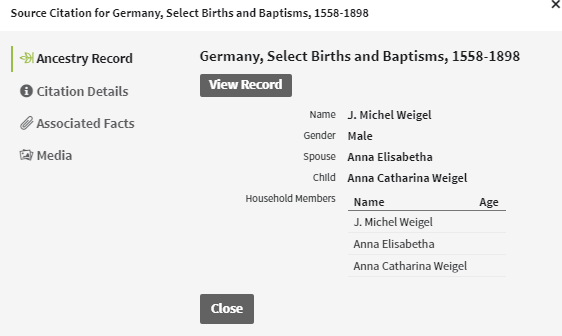
I’m sorry to say, but Johan Paul and Johan Michel Weigel are not the same person. And I can prove it with old, obscure German birth records. Johan Michel Weigel married Anna Elisabetha, and yes, they had a child named Anna Catharina, but that’s not the same person.
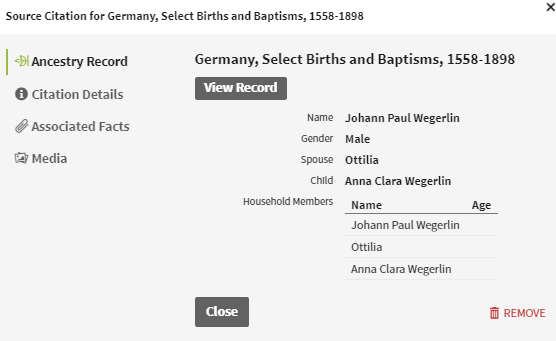
Paul, or Paulus, Wegerlin married Obtilia. We know this because they came to America together, and we have a zillion records showing they came over together with two of their daughters, for whom we also have old German birth records.
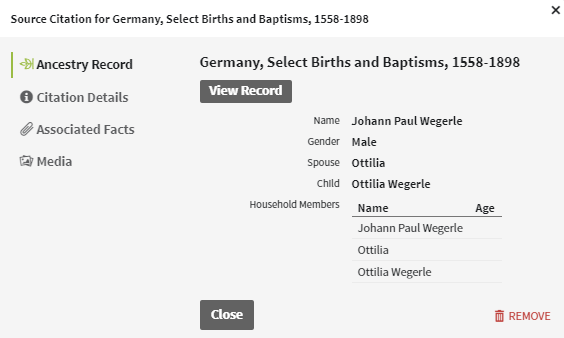
Another piece of evidence is that, in the 1736 PA Early Census Index, Johan Michael Weygell lived in Philadelphia County, and we already knew Paulus lived in nearby Lancaster County during that period.
His wife was Obtilla Wegerlin, born February 26, 1701, in Lampertheim, Bergstrasse, Hessen, Germany, and she died in November 1763 in Lancaster, Pennsylvania.
I have a document that is supposed to be her last will and testament, translated. Here is what it says.
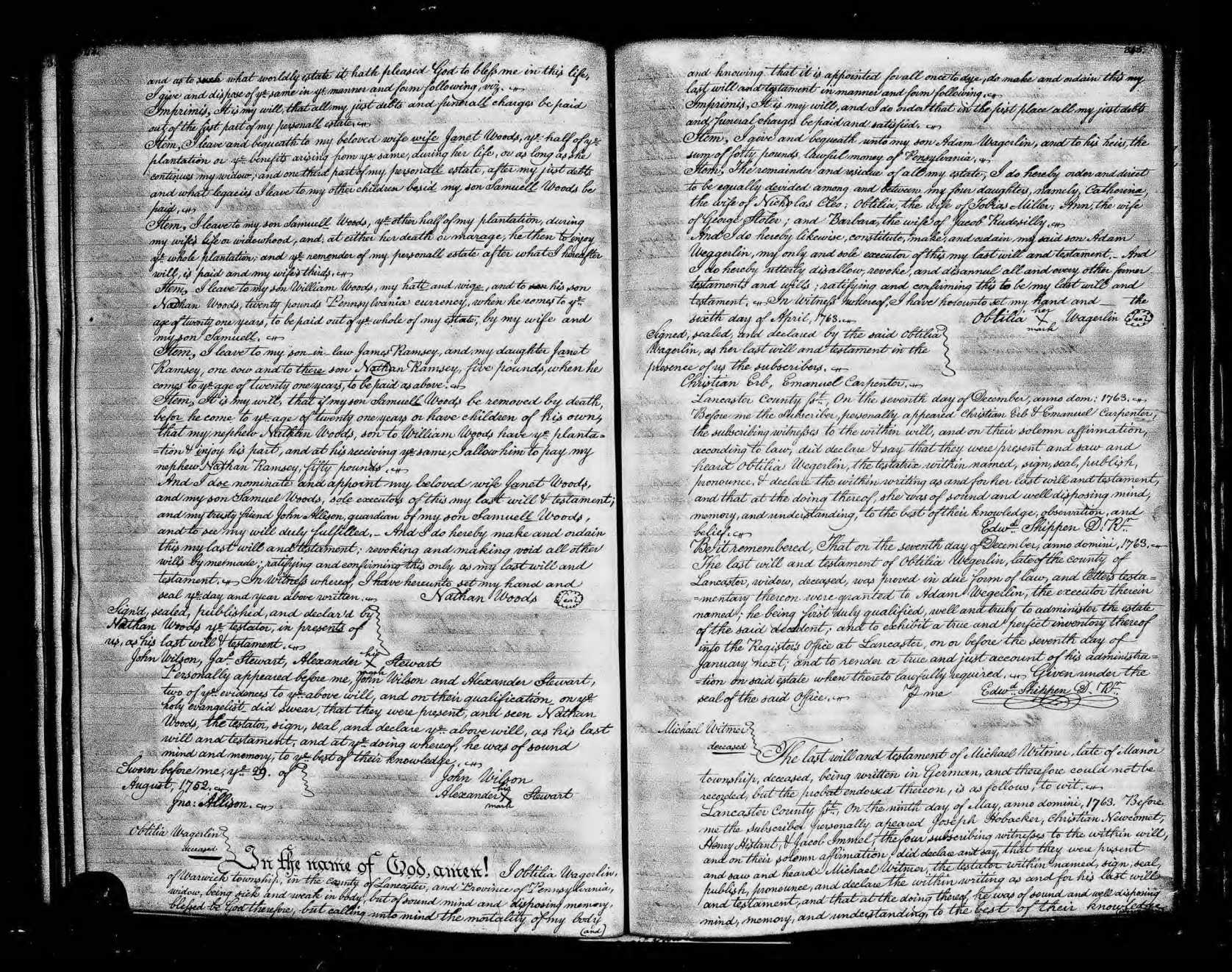
This document is a Last Will and Testament written by Ottilla Bayer, dated April 6, 1763, from Warwick Township, Lancaster County, Pennsylvania. Below is a summary and transcription of key sections for clarity.
Summary of Key Details:
- Introduction:
- The document begins with Ottilla Bayer declaring this as her final will and testament. She acknowledges her faith in God and discusses her intent to settle her worldly affairs.
- Bequests:
- Specific Property and Money: Ottilla distributes her possessions, property, and any remaining funds among her children and heirs. She names the recipients and provides detailed instructions on how her assets are to be divided.
- Care for Relatives: There is mention of provisions for family members, possibly ensuring care for those unable to support themselves.
- Execution of the Will:
- She names the executor(s) responsible for carrying out the terms of her will. Executors are likely close family members or trusted individuals.
- Closing Statement:
- Ottilla closes her will with blessings for her family and reiterates her intent that this document be followed after her death.
- Witnesses:
- The document is signed by witnesses and includes legal phrasing to validate the will under the laws of the time.
Transcription of Select Sections:
(Exact wording may vary slightly due to the old-style cursive handwriting.)
- Opening Paragraph:
“In the name of God, Amen. I, Ottilla Bayer, of Warwick Township, Lancaster County, Pennsylvania, being weak in body but of sound and disposing mind and memory, blessed be God for His mercies, do make and publish this my Last Will and Testament, revoking and making void all former wills heretofore by me made.”
- Bequests (Example Language):
“I give and bequeath unto my son [Name], the sum of [specific amount], to be paid out of my estate, and to my daughter [Name], I leave [specific property or asset], with the intent that she shall have the care of [specific individual].”
- Executor Appointment:
“I nominate and appoint [Name(s)] to be the executor(s) of this my last will, to ensure all my debts and funeral expenses are paid and the remainder of my estate divided according to this my will.”
- Closing Statement:
“In witness whereof, I, Ottilla Bayer, have hereunto set my hand and seal this sixth day of April in the year of our Lord, one thousand seven hundred and sixty-three.”
- Witnesses:
“Signed, sealed, and declared by the said Ottilla Bayer as her Last Will and Testament in the presence of us, [Names of Witnesses].”
This document outlines Ottilla Bayer’s wishes for distributing her property, ensuring care for her family, and appointing executors to manage her estate. It reflects her effort to ensure her legacy and responsibilities were handled according to her faith and values.
Here’s the catch: if you dig deep into the transcript, you see that in Ottilla Bayer’s Last Will and Testament, she distributed various items and properties to her heirs, specifying who received what. Here’s a breakdown of other people mentioned in the will and what they were given, along with their locations or the location of the items:
Heirs and Bequests:
- Maria Magdalena (daughter):
- Items Given: A feather bed with all its furniture, the largest chest, and one cow (as transcribed earlier).
- Location: These items were likely in Ottilla Bayer’s household in Warwick Township, Lancaster County, Pennsylvania.
- John (son):
- Items Given: Several farming implements, tools, and a specific parcel of land.
- Location: The land was likely located in Warwick Township or nearby areas as part of Ottilla’s estate.
- Peter (son):
- Items Given: Ottilla bequeathed him a parcel of land or rights to a property, along with some livestock and farming tools.
- Location: The land location is likely documented in Lancaster County, PA.