- Born: March 29, 1866, Mercer County, Ohio
- Died: January 5, 1946, Williston, Williams County, North Dakota
- Relationship: My first cousin, three times removed
Joseph Wegley, commonly known as Joe Wegley, was born on March 29, 1866, in Mercer County, Ohio. He was the son of
Jonathan George Wegley and Sarah A. Circle, and through his father he descended from Joseph William Wegley and Eve Berkebile of Pennsylvania.
Joseph became one of the Wegley family’s more colorful members. He left Ohio as a young man determined to become a cowboy, traveled through the developing American West, worked with cattle in Montana, eventually settled in North Dakota, became mayor of Williston, raised a large family, and later recorded many of his adventures in a memoir titled My Adventures in the West.
Growing Up in Ohio
Joseph wrote that he was born on a farm in Mercer County and that his family moved to Lockington, Ohio, when he was about nine years old. He remembered the community as lying along the Miami Canal, where freight and passenger boats were still pulled by mules.
His father, Jonathan, was a Pennsylvania German who expected his sons to work hard. Joseph later recalled that farm life never suited him particularly well because, from childhood, he had developed a determination to go west and become a cowboy.
According to Joseph’s own account, the break came when he was about twenty years old. After disagreeing with his father over cultivating corn, he left home and began supporting himself through a succession of jobs.
Working His Way West
Joseph’s memoir describes a young man willing to try almost anything as he looked for a route to the western life he wanted. He worked on farms, pulled fruit trees in a nursery, found employment in a planing mill, turned wagon hubs in a wheel factory, worked around St. Mary’s Reservoir, drove a boat on the Miami Canal, labored at a water-powered sawmill, and briefly became involved in a butcher shop.
Those jobs were not Joseph’s destination. He saved money and gained enough experience to continue west.
Joseph also wrote candidly about his younger years. While staying near St. Mary’s Reservoir, he remembered a rough social environment of fishing, hunting, dancing, drinking, and fighting, and admitted that he had developed the habit of drinking more than he thought he should. His willingness to include an unflattering detail like that makes the memoir particularly valuable because he was not simply constructing an idealized portrait of himself.
The Dream of Becoming a Cowboy
Eventually Joseph headed west alone after the friend who had planned to accompany him changed his mind. He traveled through Kansas and other parts of the West before reaching Montana, where he finally found the life he had imagined since childhood.
Joseph’s memoir places him in Glendive, Montana, where he found work with rancher Henry Lewis. He had originally been offered work as a cook but refused because, as he remembered it, he had come west to become a cowboy.
Lewis hired him for ranch work at $40 per month. Joseph initially helped with haying while learning to ride, rope, work cattle, and understand open-range customs.
Learning the Cattle Business
Joseph eventually joined a roundup representing Lewis’s cattle brand. He described arriving as an inexperienced young man surrounded by seasoned cowboys and frankly admitting to the roundup boss that he had never participated in one before but wanted to learn.
He learned quickly.
His memoir contains stories of practicing his roping skills, sleeping on the prairie, standing night guard over cattle, crossing the Yellowstone River, encountering wildlife, and learning the sometimes dangerous routines of working cattle on the open range. He remembered the experience as the realization of a childhood ambition.
One particularly memorable episode involved Joseph helping hold down a cow while it was branded. After he released her and remained standing nearby, the angry cow charged him, forcing him to run around his horse until another cowboy finally roped the animal.
These were the experiences Joseph had imagined when he was still a boy on an Ohio farm. By the time he was in Montana, the would-be cowboy had actually become one.
A Caution About the Memoir’s Timeline
Joseph’s memoir is an extraordinary family source, but it should not automatically be treated as a day-by-day historical chronology. Some of the dates and sequences in the surviving account are difficult to reconcile with one another.
For example, Joseph described attending an Oklahoma land rush before recounting his arrival in Glendive in July 1887. The famous Oklahoma land openings occurred later, so either a date, sequence, or Joseph’s recollection became confused when the memoir was written or transcribed.
That does not make the memoir useless. It simply means Joseph’s personal recollections should be combined with contemporary records whenever precise dates matter.
Marriage to Tena Olson
Joseph eventually married Tena Olson, whose name sometimes appears incorrectly in later records as Tina. The family records I have examined support Tena as the spelling she herself used and as the spelling found in multiple contemporary sources.
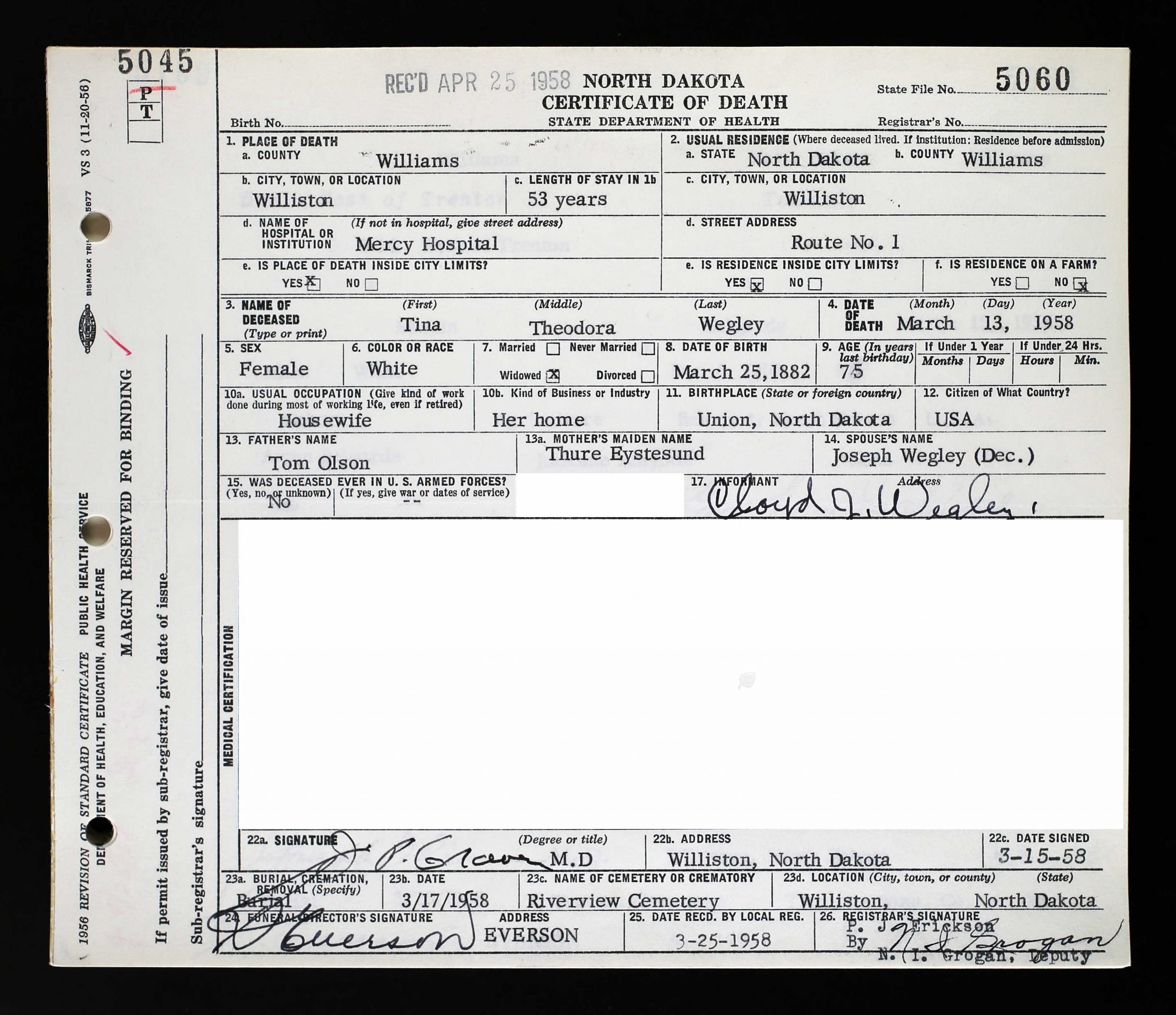
Tena was born on March 25, 1882, in North Dakota. Her death certificate identifies her as Tena Theodora Wegley, and she died on March 13, 1958, in Williston, surviving Joseph by more than twelve years. We know when she died because we have her death certificate.
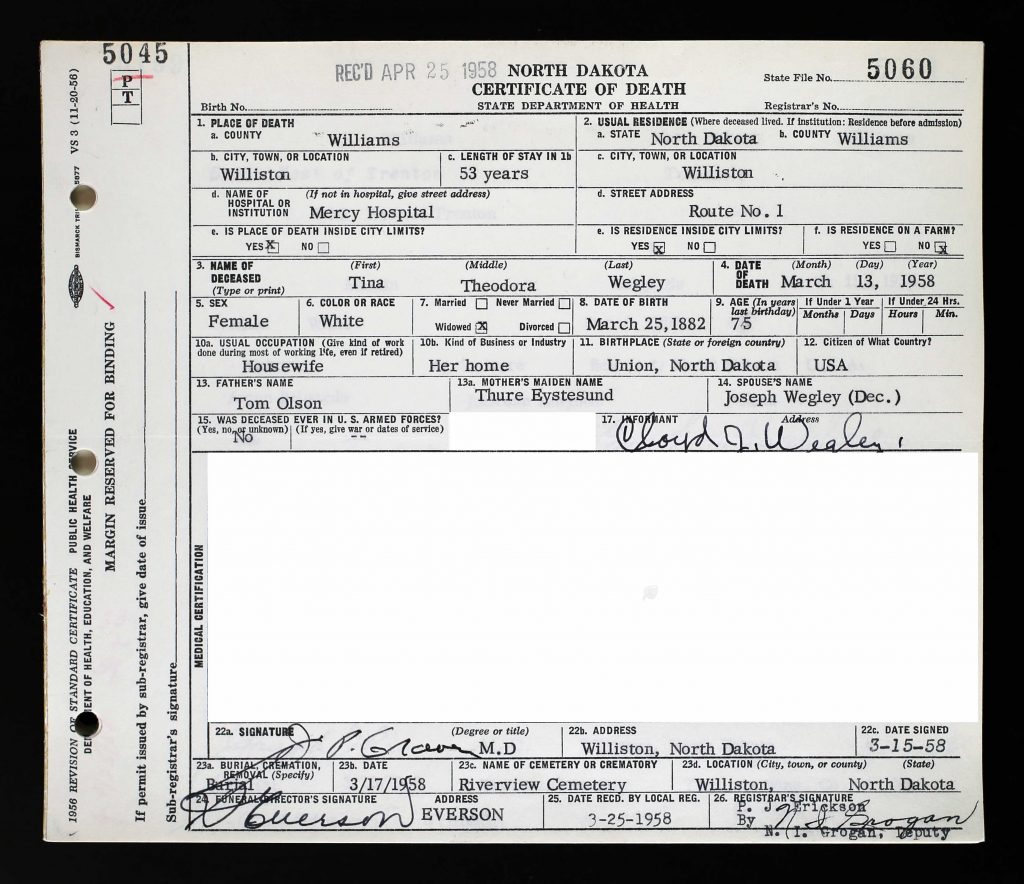
| Field |
Information |
| Name as recorded |
Tina Theodora Wegley |
| Sex |
Female |
| Race |
White |
| Marital status |
Widowed |
| Date of birth |
March 25, 1882 |
| Age at last birthday |
75 |
| Birthplace |
Union, North Dakota |
| Citizenship |
USA |
| Date of death |
March 13, 1958 |
| Place of death |
Mercy Hospital |
| City |
Williston, North Dakota |
| County |
Williams County |
| Inside city limits |
Yes |
| Length of time in Williston |
53 years |
| Cause of death |
Not visible on this copy |
| State |
North Dakota |
| County |
Williams County |
| City/location |
Williston |
| Street/rural address |
Route No. 1 |
| Residence inside city limits |
Yes |
| Residence on a farm |
No |
| Father |
Tom Olson |
| Mother’s maiden name |
Thure Eystesund |
| Husband |
Joseph Wegley |
| Husband’s status |
Listed as deceased, “Dec.” |
| Informant |
Cloyd J. Wegley |
| Usual occupation |
Housewife |
| Business or industry |
Her home |
| Ever served in U.S. Armed Forces? |
No |
| Disposition |
Burial |
| Burial date |
March 17, 1958 |
| Cemetery |
Riverview Cemetery |
| Cemetery location |
Williston, North Dakota |
| Funeral director |
Signature appears associated with Everson |
| Funeral home/address field |
EVERSION / EVERSON, as written or stamped |
| Certifying physician |
Signature is difficult to read with certainty |
| Physician location |
Williston, North Dakota |
| Date physician signed |
March 15, 1958 |
| Date received by local registrar |
March 25, 1958 |
| Date received by state |
April 25, 1958 |
| State file number |
5060 |
| Number printed at upper left |
5045 |
Their Children
You might find references to “Tina Wegley,” which could lead you astray in your research. Just keep in mind her name was legally “Tena,” and that is what you’ll find on official records, including the US census.
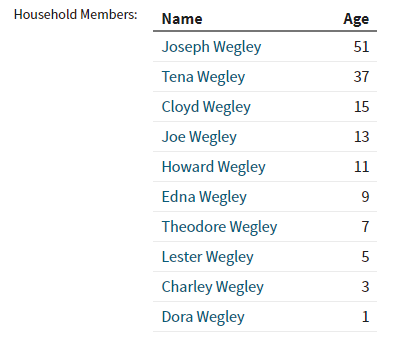
Some information about their children was confusing. I had to do a lot of digging and cross-referencing to get their children’s names down right. In the 1920 US Census, we can see all of their children listed minus their youngest, Orville, who wasn’t born yet.
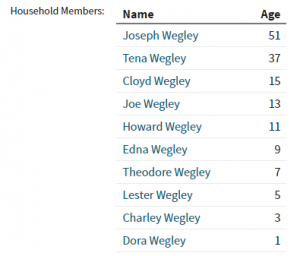
If you have any children (aother than the 9 from above) listed for Joseph and Tena Wegley then you are mistaken and need to re-verify your information.
They lived at 211 East 2nd Street in 1911, right down the street from his brother Fred and his wife Alice, who lived at 223 East 2nd Street. We know this from the town directory, which the local paper published from time to time.
US Census records show he owned his home, valued at $1,500. It was a farm, and he owned a radio (like us having a TV today). He did not go to school, but he could read and write.
My current research supports nine children of Joseph and Tena:
- Cloyd J. Wegley
- Joe A. Wegley
- Howard Joseph Wegley
- Edna Josephine Wegley
- Theodore J. Wegley
- Lester J. Wegley
- Charles Joe Wegley
- Dora V. Wegley
- Orville “Jack” Wegley, born October 26, 1920
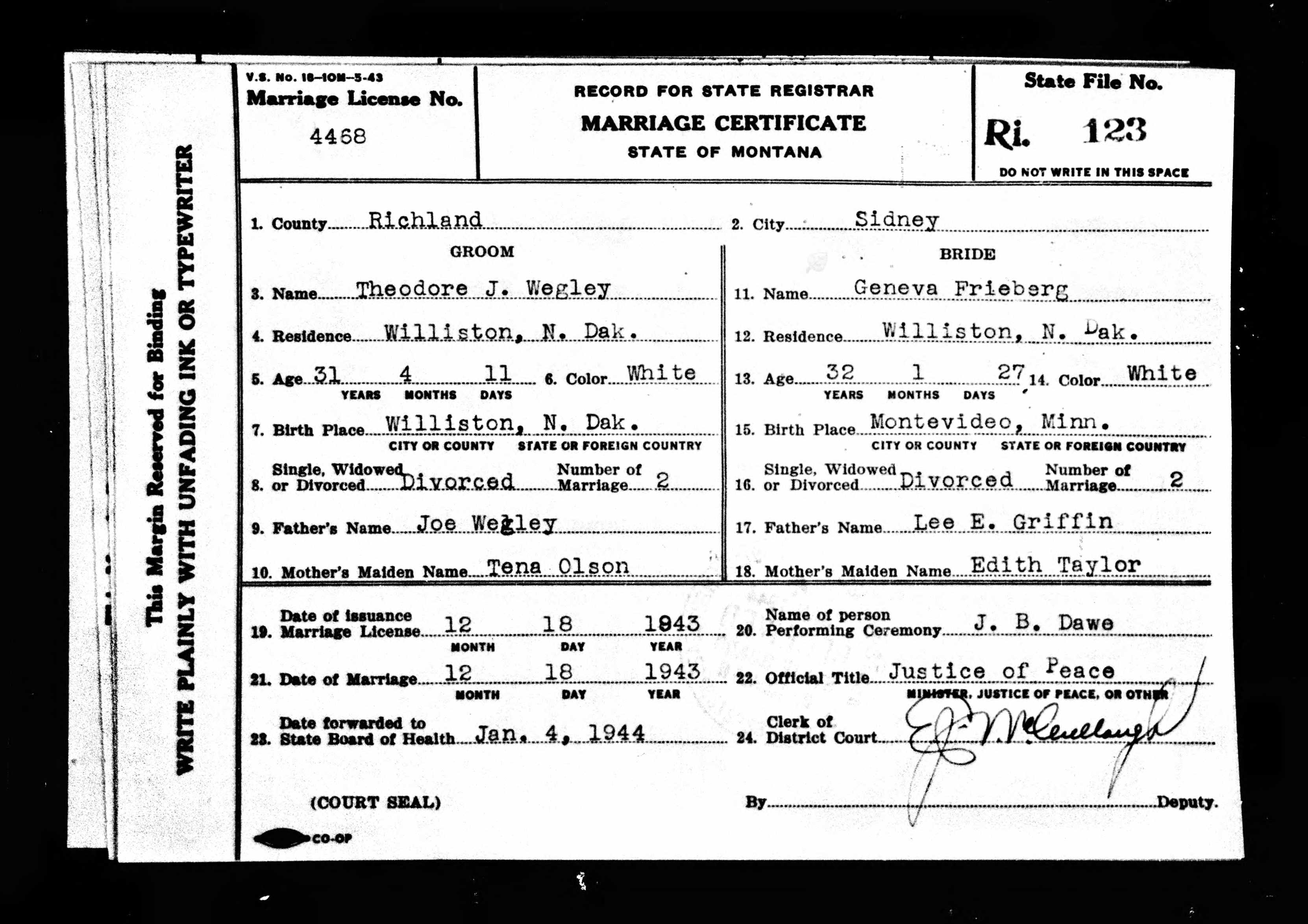
The 1920 United States census provides an especially useful snapshot of the household before the birth of their youngest son, Orville. Later records continue to confirm individual relationships, including Theodore J. Wegley’s 1943 marriage certificate, which identifies his parents as Joe Wegley and Tena Olson.
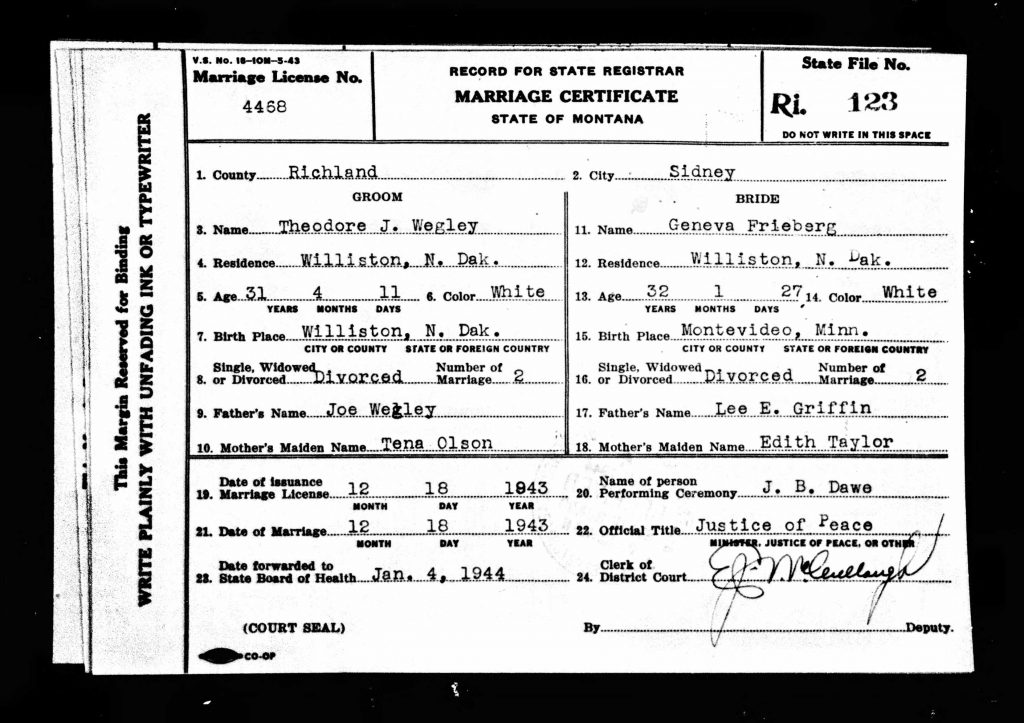
| Field |
Information |
| Marriage license no. |
4468 |
| State |
Montana |
| County |
Richland County |
| City of marriage |
Sidney, Montana |
| Groom |
Theodore J. Wegley |
| Groom’s residence |
Williston, North Dakota |
| Groom’s age |
31 years, 4 months, 11 days |
| Groom’s race |
White |
| Groom’s birthplace |
Williston, North Dakota |
| Groom’s marital status |
Divorced |
| Marriage number for groom |
2nd marriage |
| Groom’s father |
Joe Wegley |
| Groom’s mother |
Tena Olson |
| Bride |
Geneva Frieberg |
| Bride’s residence |
Williston, North Dakota |
| Bride’s age |
32 years, 1 month, 27 days |
| Bride’s race |
White |
| Bride’s birthplace |
Montevideo, Minnesota |
| Bride’s marital status |
Divorced |
| Marriage number for bride |
2nd marriage |
| Bride’s father |
Lee E. Griffin |
| Bride’s mother |
Edith Taylor |
| Marriage license issued |
December 18, 1943 |
| Marriage date |
December 18, 1943 |
| Officiant |
J. B. Dawe |
| Officiant’s title |
Justice of the Peace |
| Forwarded to State Board of Health |
January 4, 1944 |
Life in Williston
Joseph and Tena became firmly established in Williston, North Dakota, a rapidly developing community near the Missouri and Yellowstone rivers. By 1911, a local directory placed them at 211 East Second Street.
Joseph’s brother Fred and Fred’s wife Alice lived nearby at 223 East Second Street. The two Wegley households were therefore only a short distance apart, providing a tangible glimpse of the extended family living within the same neighborhood.
A later federal census records Joseph as owning his home, valued at approximately $1,500, and identifies the property as a farm. The household also owned a radio, which by that period had become an important source of news and entertainment.
The census records Joseph as able to read and write. I would not interpret a negative response to the census question about school attendance as proof that he had never attended school, because that question referred to attendance during a specified recent period rather than necessarily documenting an individual’s entire educational history.
Williston’s First Mayor and a Scandal
Joseph’s political chapter began during a turbulent period in Williston’s early history. The city’s first mayor, William H. Denny, was a banker, rancher, and businessman who became entangled in allegations that he received and sold stolen horses.
Denny was convicted in 1906 of selling stolen horses and sentenced to prison, although the conviction was later overturned and the disappearance of important evidence prevented another successful prosecution. Denny resigned as mayor during the controversy.
Joseph Wegley succeeded him.
City records reported Denny’s resignation and Joseph’s election as mayor in 1906. Joseph therefore entered municipal leadership at a particularly unsettled moment in Williston’s history.
Joseph Wegley Elected Mayor
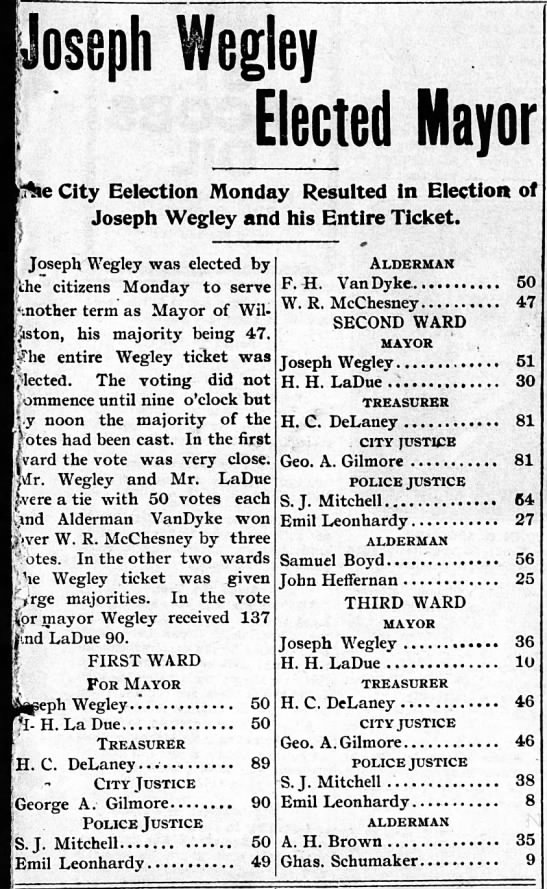
A surviving newspaper clipping records Joseph’s election to another term as mayor and reports that his entire political ticket was elected with him. The mayoral vote was remarkably detailed:
- Joseph Wegley: 137 votes
- H. H. LaDue: 90 votes
- Joseph’s majority: 47 votes
The First Ward ended in a 50-to-50 tie between the two mayoral candidates, but Joseph won decisively in the other wards. He received 51 votes to LaDue’s 30 in the Second Ward and 36 to 10 in the Third Ward. The result shows that Joseph was not simply appointed to fill an empty office and forgotten. He developed enough political support to win another term from Williston’s voters.
Cleaning Up the “Blind Pigs”
Joseph remembered early Williston as a rough western town with numerous saloons and illegal drinking establishments. Such illicit liquor businesses were commonly called “blind pigs.”
As mayor, Joseph became associated with efforts to suppress illegal liquor sales and gambling. A 1907 newspaper report described him as conducting a vigorous campaign against gambling and blind pigging, demonstrating that his reputation as a reform mayor was not merely something added to the story decades later.
His enforcement efforts were controversial. A man arrested during one of those campaigns later sued Joseph for malicious prosecution and false imprisonment, and the litigation eventually reached the North Dakota Supreme Court.
When His Own Brother Was Accused
Joseph’s reform campaign became much more complicated when his own brother Fred Wegley was accused of illegally selling intoxicating liquor. A November 1907 newspaper report said authorities had issued a warrant for Fred in connection with an alleged establishment known locally as “
Wegley’s Pig.”
The allegation immediately created an obvious political problem for the mayor. Critics claimed Joseph was suppressing other illegal drinking establishments while allowing his brother to operate one.
Fred repeatedly denied the allegations and was acquitted. A June 1909 report said he had been tried three times before justices of the peace and found not guilty each time, then indicted by a grand jury and again acquitted after a jury deliberated for only three minutes.
The newspaper reported that Fred’s supporters believed the prosecution had been politically motivated and intended to damage Joseph’s reputation. Whatever the political motivations, the episode shows how contentious Joseph’s efforts to enforce Williston’s liquor laws had become.
From Cowboy to Mayor
Joseph’s journey to the mayor’s office becomes even more remarkable when set against the life he described in his memoir. He had started as an Ohio farm boy who disliked farm life, dreamed of becoming a cowboy, worked his way west through a string of temporary jobs, and eventually rode the open range in Montana.
Years later, he was helping govern a rapidly growing North Dakota city. Those two versions of Joseph were not really separate. His memoir suggests a man who valued independence, disliked being told what he could not do, and repeatedly took risks when he believed another opportunity lay ahead.
My Adventures in the West
Late in life, Joseph preserved many of his experiences in a self-written memoir titled My Adventures in the West. The account is unusually important to our family history because most nineteenth-century Wegleys left records created by census takers, ministers, clerks, courts, and government officials, while Joseph left something in his own voice.
He wrote about his childhood, his disagreements with his father, his early jobs, drinking, travel, cattle work, cowboys, open ranges, dangerous river crossings, wildlife, and the people he encountered while making his way west. Even where individual dates require verification, the memoir preserves something no census can provide: Joseph’s own memory of what his life felt like.
The surviving text is also filled with humor. Joseph was willing to make himself the target of the joke, whether describing accidentally putting salt in his coffee at a roundup camp or running in circles around his horse while an angry cow tried to catch him.
The Wegley Farm
In his later years, Joseph appears in federal records as a homeowner and farmer in the Williston area. The shift from wandering young cowboy to established property owner and father of nine shows how much his life changed after he settled in North Dakota. His family became part of the Williston community. His children remained connected to the area, and decades later, his youngest son Orville “Jack” Wegley’s records still identified Williston as home.
January 5, 1946
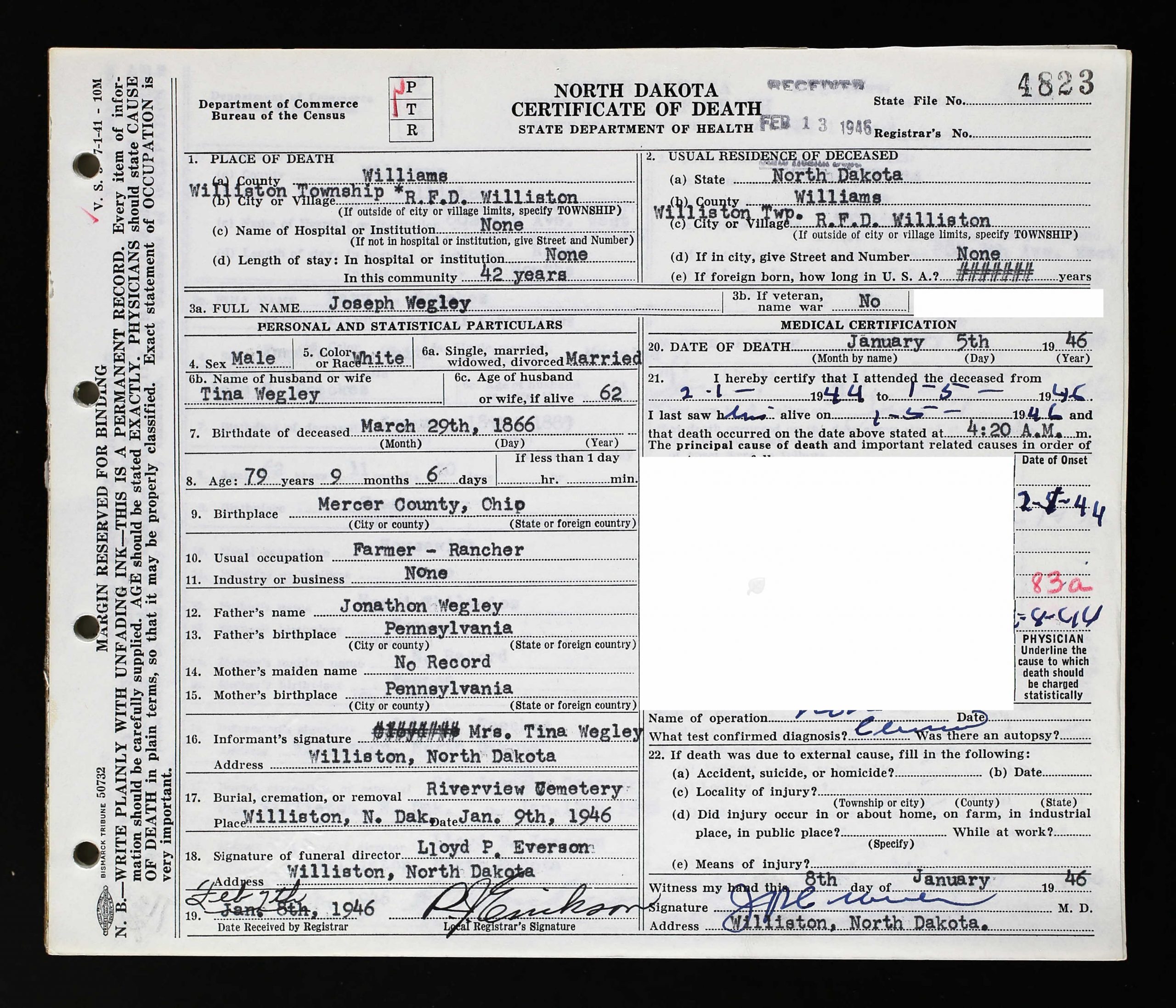
Joseph Wegley died on January 5, 1946, in Williston, North Dakota. He was seventy-nine years old. Tena remained in Williston after his death and survived until March 13, 1958. Their decades together produced a large family whose records continue to tie the Wegley name to northwestern North Dakota.
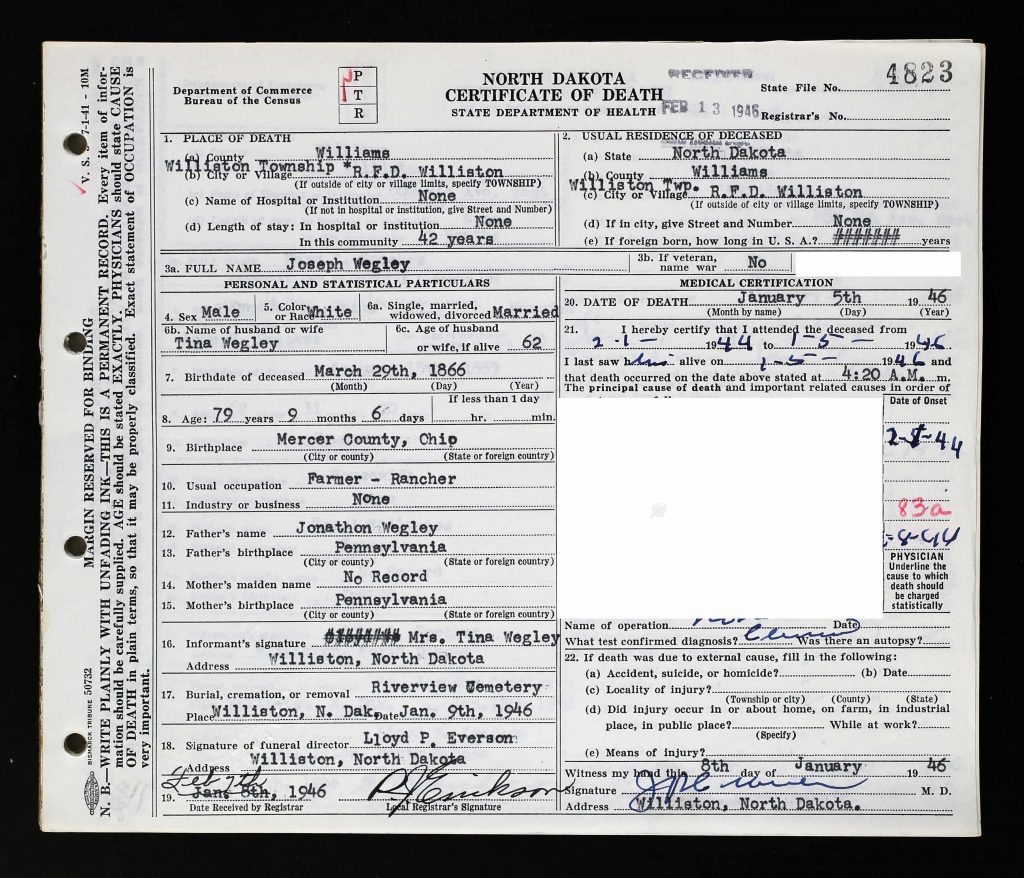
| Field |
Information |
| Full name |
Joseph Wegley |
| Sex |
Male |
| Race |
White |
| Marital status |
Married |
| Wife |
Tina Wegley |
| Wife’s age |
62 |
| Date of birth |
March 29, 1866 |
| Age at death |
79 years, 9 months, 6 days |
| Birthplace |
Mercer County, Ohio |
| Veteran |
No |
| Date of death |
January 5, 1946 |
| Time of death |
4:20 a.m. |
| County of death |
Williams County, North Dakota |
| Place of death |
Williston Township, R.F.D. Williston |
| Hospital or institution |
None |
| Length of time in community |
42 years |
| Usual residence state |
North Dakota |
| Usual residence county |
Williams County |
| Usual residence |
Williston Township, R.F.D. Williston |
| Street address |
None listed |
| Usual occupation |
Farmer and Rancher |
| Industry or business |
None |
| Father’s name |
Jonathan Wegley |
| Father’s birthplace |
Pennsylvania |
| Mother’s maiden name |
No Record |
| Mother’s birthplace |
Pennsylvania |
| Informant |
Mrs. Tina Wegley |
| Informant address |
Williston, North Dakota |
| Cause of death |
Obscured on this copy |
| Physician last saw him alive |
January 5, 1946 |
| Physician signed certificate |
January 8, 1946 |
| Physician location |
Williston, North Dakota |
| Burial date |
January 9, 1946 |
| Cemetery |
Riverview Cemetery |
| Cemetery location |
Williston, North Dakota |
| Funeral director |
Lloyd P. Everson |
| Funeral director location |
Williston, North Dakota |
| Date received by local registrar |
January 9, 1946 |
| Date received by state |
February 13, 1946 |
| State file number |
4823 |
Joseph’s Place in the Wegley Story
Joseph’s life is one of the rare places in this family history where an ancestor’s personality emerges almost as strongly as his genealogy. We have dates, census records, city directories, election returns, newspaper reports, court records, photographs, and records created by his children, but we also have Joseph speaking for himself.
He began life on an Ohio farm and spent his youth imagining the West. He eventually became the cowboy he had dreamed of being, settled in North Dakota, raised nine children with Tena, became mayor of Williston, fought gambling and illegal liquor establishments, weathered political controversy involving his own brother, and lived long enough to write down the adventures of his younger years.
For a family historian, that makes Joseph particularly valuable. Most ancestors leave us enough evidence to reconstruct where they went and what they did, but Joe Wegley left us something rarer: his own version of the story.
————
Here is a copy of a story from the ‘Grand Forks Herald’, Grand Forks, North Dakota. 8 Nov 1907
Williston, N. D., Nov. 7 – A warrant has been issued for Fred Wegley, a brother of the mayor, the charge being the illegal sale of intoxicating liquors in what is commonly known as “Wegley’s Pig,” the joint in the lower regions of the concrete building on East Broadway. The warrant was issued this morning and is now in the hands of the sheriff, who will serve it as soon as the defendant can be found, the understanding being that he has left the city temporarily.
‘Grand Forks Herald,’ Grand Forks, North Dakota. 10 June 1909
Williston, N. D., June 9 – Fred Wegley has been acquitted. The jury in the case was out just three minutes this morning when it returned a verdict of not guilty. This case has attracted attention for the last year and a half on account of the accused being a brother of Former Mayor Joseph Wegley, who has the reputation of being the man who cleared Williston of blind pigs, and it was asserted that the mayor was protecting his brother and allowing him an exclusive right to conduct a “pig.”
The accused was tried three times before justices of the peace, and each time, he was found not guilty. He was then indicted by the grand jury, on which indictment he was just found not guilty.
The outcome of the case convinces Wegley’s friends that the case was only a piece of spite work on the part of those opposed to Mayor Wegley to throw suspicion on the sincerity of his administration.
Here’s a crazy story about how he became mayor in the first place.
Fact: First North Dakota mayor accused of horse rustling
Williston’s first mayor, William Denny, did a lot to make it the state’s fastest-growing city during the first decade of the 20th century, growing from 763 people in 1900 to 3,124 in 1910, a rate of more than 300 percent. Denny was also suspected of being the ringleader of a large horse-rustling organization. Denny established the first bank in Williston when he arrived in February 1899. He also had a large ranch on which he raised horses and Hereford cattle. He had connections in Montana, where many horses were brought to his ranch and sold to him at $10 to $30 a head. Because northwestern North Dakota was rapidly filling up with homesteaders, Denny could sell each of the horses to the settlers for $150. Initially, most Williston residents considered Denny a shrewd businessman. In June 1904, Denny was elected mayor and went to work to provide electricity and running water for the residents. He ran unopposed for re-election in 1905, and later that year, Denny was arrested, convicted, and sentenced to prison for being the fence of a large horse-stealing enterprise in Montana. He appealed to the North Dakota Supreme Court for a retrial, which was granted to him since key pieces of evidence against him had disappeared. With the major evidence missing, a new trial never occurred, and Denny was set free. William Henry Denny Jr. was born in New Auburn, Minn., on March 17, 1870, to William Sr. and Marian (Joslyn/Josline) Denny. William Sr. was a gunsmith, and the family moved to the larger town of Glencoe soon after William Jr.’s birth. In 1885, William Jr. attended Anoka Business College and after graduating two years later, “worked at various stores in St. Cloud.” In the fall of 1889, he traveled to Montana and found work as a ranch hand on the Diamond G Ranch, which was owned by J. D. “Dad” Williams. Also working for Williams was “Dutch Henry” Jauch (pronounced Yaw), who later organized “the largest horse stealing operation in eastern Montana.” Williams found Denny to be trustworthy and asked the youngster to drive horses to central North Dakota to be sold. On his drives, Denny established friendships in Benson County, and he developed a romantic interest in Kate Huffnail, a school teacher in Minnewaukan. He moved to Minnewaukan in 1897 and, in July, went to work for the Benson County State Bank.
After working for a couple of years and learning how to operate a bank, Denny began exploring new opportunities. Seeing that the Great Northern Railway had reached Williston in 1898 and that it was about to establish branch lines from there to towns in the northwestern part of the state, he knew that settlers were soon to follow. Williston did not have a bank, and the town was ideally located near the confluence of the Yellowstone and Missouri rivers.
In 1898, Denny contacted Charles Hilton Davidson, a wealthy Canadian real estate dealer, and Thomas L. Beisaker, a Fessenden banker, who also owned a number of other banks in North Dakota and Minnesota, and the two men agreed to finance the establishment of a bank in Williston. When the Williams County State Bank opened on Feb. 19, 1899, Denny was named cashier and manager. Feeling financially secure, he married Kate on March 8.
From the money Denny was making at the bank, he began purchasing land between Williston and the Montana border on which to raise cattle and horses. His plan was to buy horses brought in from Montana and sell them to the homesteaders who were coming into northwestern North Dakota. Denny also began selling real estate and, in 1903, established the town of Trenton on his property.
On Feb. 3, 1904, Williston was incorporated as a city, and four months later, the newly elected councilmen chose Denny as mayor. According to Joseph Wegley, Denny’s successor as mayor, Williston was a wild-west town. Wegley wrote, “There were eleven saloons or blind pigs on Main Street and lots of them in the alleys … blind pigs prevailed and ruled the city.” Wegley also pointed out that Denny was in support of the saloons.
In 1905, Denny was re-elected, and he sent out bid proposals for the construction of city waterworks and an electrical plant. Besides serving as mayor, he also was kept busy buying and selling horses. On Oct. 26, law officers from Montana went to Denny’s ranch and discovered stolen horses. Denny and Art McGahey, the man who delivered the stolen horses, were arrested. Denny’s lawyers pointed out that the lawmen had presented insufficient evidence, and the arrest was rescinded.
Suspicion that Denny was the fence and possibly the kingpin of a large horse-rustling organization surfaced in September when Jack Teal, a Montana lawman, and George Hall, the stock inspector for the Montana Stockmen’s Association, arrested a horse thief. When the thief tried to escape, he was shot and killed. Teal and Hall went through the dead man’s belongings and discovered a letter that named Denny as the “chief fence” for stolen horses.
This information was corroborated by George Miller, a saloon owner whose establishment had recently been robbed by horse thieves. He told Hall and Sheriff William Griffith about an incident in which Tom Ryan, who had injured his writing hand, had Miller write a letter to Denny. “Ryan was the major rustler in eastern Montana now that Jauch had disappeared.” The letter stated that Ryan was having McGahey deliver horses to Denny.
Miller agreed to work with the lawmen. To make certain that the horses had been delivered, he went to the mayor’s ranch, posing as Ryan’s friend. Denny confirmed to Miller that the horses had arrived and had been sold. Denny also told Miller to tell Ryan to stop visiting his bank because “Montana authorities were breathing down his neck.”
Armed with this additional evidence, law officials returned to Denny’s ranch in mid-November to arrest him, but he was gone. He had been tipped off and fled to Benson County. The lawmen located Denny in Churchs Ferry and arrested him, but they were unable to take him into custody because the district judge, John Cowan, issued a habeas corpus decree declaring Denny needed to appear in court before he could be detained.
A trial was scheduled for August 1906, but Montana authorities did not believe justice would be served. In December 1905, Montana’s governor, Joseph Toole, made a request to Elmore Sarles, governor of North Dakota, that Denny be extradited, and Sarles agreed. However, Denny’s lawyers were able to get the extradition order rescinded.
At his trial on Aug. 9, 1906, Denny was found guilty of selling stolen horses and sentenced to three years in prison. However, Denny’s lawyers appealed to the North Dakota Supreme Court for a retrial. The letters showing Denny’s involvement disappeared, before the court met on Oct. 11, 1908, and the court ordered a retrial. Since the prosecution no longer had their most important evidence, a new trial never occurred, and Denny no longer feared conviction.
Although Denny was basically free, “he was a broken man, and he never recovered.” He resigned from his positions at the bank and as mayor. Denny remained in Williston and sold real estate until the 1930s when he lived in Montana and California for short periods of time. He returned to Williston, where he died on July 9, 1936.
My Adventures in the West by Joseph Wegley
He wrote a book called, “My Adventures in the West” which was a story about his life. Here are some excerpts from the self-published book.
I was born on a farm in Mercer County, Ohio. When nine years old, we moved to Lockington, Ohio, in the Miami Valley, one of the most beautiful and fertile valleys I have ever seen. I lived on a farm there four miles north of Piqua on a little inland town named Lockington, located on the Miami Canal, which ran from Toledo to Cincinnati, Ohio. At the time, this canal had both freight and passenger boat service, and the boats were pulled by mules. This transportation was slow, but sure.
From this little town, Lockington, we moved out into the country ten miles on a farm, which, of course, didn’t quite suit my fancy.
My mother was English, Scotch, and Irish. My father was a conservative Pennsylvania German, and he saw to it that we boys did plenty of work; I thought too much.
For some unknown reason, I made up my mind when I was just a little boy that I would someday be a Western cowboy. This idea never faded from my mind, so this farm life didn’t quite suit me.
When I was about twenty, my father and I had a disagreement about cultivating corn. Of course, being a boy, naturally, I thought I knew more than my father, so I left home, still having this Western idea in my mind. This was in June.
My first job was on a farm. For six weeks, I stood in a barnyard pitching cow manure, but I stayed until the job was finished. From ther,e I got a job in a nursery pulling fruit trees. The foreman, I thought, and think yet, was a slave driver, but I stayed through the job. Then I got a job in a planning mill in Sidney, Ohio, which I liked fairly well, but the boss didn’t raise my wages as fast as I thought he should, so I quit this job and went to work in a wheel factory in Sidney. I worked turning wagon hubs until the factory burned down.
It was fall, and I went to a brother’s place on St. Mary’s Reservoir, which was an artificial lake near St. Mary’s, ten miles long and five miles wide, and was a fishing and hunting resort. The life there was fishing, hunting, dancing, drinking, fighting, and all that goes with such a vocation. The associations there were not the best, in fact, they were rough, but being young and looking for thrills, I liked it, but cultivated the habit of drinking a little too much, although I was able to see it myself.
When spring came, I left there and got a job driving a boat on the Miami Canal. My associates, there were bullies as bad, or possibly worse, than the fishermen, but I had sworn off drinking. That meant I had to quit.
After a while, after seeing the inside life of a boatman, I quit and went to work in a water power saw mill in Lockington, Ohio. I also went into partnership with a man there in a butcher shop. Well, business was bad in the shop. Lots of meat spoiled; so when one beef was gone, I usually had to put some of my wages in to buy another beef. However, I managed to save a little money.
The next spring, I made up my mind to go west looking for the job of my ambition. My folks, of course, didn’t like the idea and said the wild cowboys would kill me and if they didn’t the Indians would. I said that those cowboys started sometime, and that I could, and as for the Indians, I was willing to take a chance. A boy friend of mine was going along, but when the time arrived, he got cold feet; but I said, “I’m going!” and so I started.
I had scarcely been out of the county I was raised in. I bought a ticket to southern Kansas hunting my way to some cattle range. I got a job in a livery barn, but I didn’t like that job so I quit. I went to the Oklahoma boom when 30,000 men rushed in there for claims, but there were only 8,000 claims to be taken. Naturally, lots of them were left out. I, of course, was just out to see what it was all about, in other words, seeing the country.
The people were held back on the Kansas side until twelve o’clock noon when a cannon was fired and the rush started. We had to cross the Cherokkee strip forty miles wide. Some went on foot, some by train, some in wagons, some on horse back – any old way to get a claim. Many had been in and staked their claims so as to know just where to go at the right time. One man from Kansas gave $50.00 for the use of a race horse to go to his stake claim. When he got there, a man was plowing on his claim with a team of oxen – the secret being the people had been removed from the district, but some of the old timers had hid themselves in brush, etc. until twelve o’clock and then went out and went to work.
After the boom was over, I went back to Kansas and started beating my way over the country and wound up in Missouri. I worked on a farm there for six weeks.
Having satisfied myself that Montana was the range I had been looking for, I quit my job and started north beating my way through Kansas City, St. Paul, and then west. I had a little money but wanted to try anything for the experience. I had the time of my life on this trip with other hoboes.
I quit a job in Missouri at $15.00 per month and beat my way to Glendive, Montana. I lost just a week’s work, and went to work for $40.00 per month. I got to Glendive on a Saturday evening in July, 1887 on a freight and went over to a small restaurant for supper. The boss offered me a job cooking. I said I could not cook, but he said he could show me all I needed to know in twenty minutes. But, I said I came to this country looking for a job as a cowboy not cooking, so he told me about a man thirty miles in the country up the Yellowstone river on the north side who was in town that day looking for a man.
Well, Sunday morning I went down to the cable ferry to cross the river, planning to walk the thirty miles. The ferryman asked twenty-five cents to take me across. I said that I could swim it cheaper and I had just little enough knowledge of the west to try it. The atmosphere being so different, it looked like it was just a short distance across; so I started looking for a place to start. Accidentally, I met an old gentleman and told him my plans. He was one of those real men typical of that country and he said, “Say young man, don’t try it in the first place. It is further across this river than it looks to you. Besides, it is dangerous as it is full of whirlpools, undercurrents, and you will lose your life if you try it.” I took the old fellow seriously and paid the ferryman the twenty-five cents, and believe me, when we got out into the current, I realized what the old man meant.
I started on my journey and hadn’t gone but two miles when I came to a house. I went in to ask directions, and found to my surprise that the man who wanted to hire a hand had stayed there over night and had not left yet. He at once asked me if I was looking for work, and he offered me $40.00 per month. I took the job and got in his wagon and started for his ranch.
Driving up the Yellowstone Valley, to me, was the most beautiful sight I had ever seen, just prairie and hills with no one living there.
This man, Henry Lewis, was a real old-time cowboy but had settled on a small ranch and was married and had a nice wife and two children. He was running a bunch of cattle for an Iowa firm on shares on the range, but there was no roundup for about a month, so he asked me if I had any objections to haying. As cowboys at that time wore kid gloves, seven dollar pants, fourteen dollar boots, and refused to do anything but work with cattle or ride horseback, I told him I would be glad to hay until round-up time, which I did. He had a bunch of saddle horses which were at my command any time I wasn’t busy, and we didn’t work like they do on a farm so I had lots of spare time.
Through this man’s general knowledge of cowboy work, and my ability to ask questions along with my long hours of practice in riding and roping, I learned a whole lot about the business, before the round-up started. I practiced roping on jack rabbits and coyotes. I had met several cowboys who used to come around occasionally to visit my boss. I had hunted some during the time game was plentiful. There were deer, antelope, and many small animals in abundance. We used wild meat almost entirely for fresh meat.
Well, finally round-up time came and I realized the dream of my life. For the benefit of anyone who read this, I will give a brief idea of what a round-up means. In the first place, this is what they call an open range. It belongs to the United States, no individuals, but they have gentlemen’s agreements as to the range they claim. For instance, the country is drained by creeks which are all named. John Doe has a ranch on Porcupine Creek. He also claims Cedar and Cottonwood creeks; those creeks are his for his range. Another man has similar ranges. Well, the cattle run loose and get all over the whole range to some extent.
The general round-up, which is held every spring, means each ranch sends out a wagon, his bunch of punchers, along with their saddle horses. The wagon means a mess or grub wagon which carries the boys’ beds, a cooking outfit, grub, etc. The cook usually drives the wagon from one camp to another. Those outfits, as they are called, all go together in the spring and start at one end of the range. One man is appointed round-up foreman and he is boss of all the work on this general round-up. He directs the riders from one camp to another, that is, he sends them to certain parts to bring in all the cattle they find. They all come in to camp.
The horse wranglers look after and move the saddle horses. When the cattle are assembled, the cowboys usually eat dinner, change horses, and cut out the cattle that belong to the man on the particular range they are on, and leave them on what they call his home range. Then they night-herd the general herd. The next day, they move and perform as before until the whole range is worked.
Then each ranch has its beef round-up in the fall and ship their beef. If a neighbor’s cattle is found on the beef round-up, they cut out his beef and ship it. The brand inspector at the terminal sends the money to the proper person. Brands are recorded the same as deeds to farms.
Well, this man Lewis who I worked for didn’t have a big enough outfit to send out a wagon, so he sent me out representing his brand. That meant that I was to look after his interests. Well, he gave me eight head of saddle horses and a bed, which we tied to one of the horses. He told me where to find the outfit, which was twenty miles distant, and gave me the general direction, thus starting me out on one of the happiest moments of my life. I would not have changed places with the president; in fact, I don’t know if his overcoat would have made me a vest.
I found the outfit at dusk in the evening and drove my string of horses near the wagon. A man came and helped me put them in a rope corral by the wagon for this purpose.
A rope corral is two ropes, one stretched in such a way as to be wider in the middle than the outer end where the horses are put in. One end is stretched from the front wheel, and one from the hind wheel about three feet from the ground. The horses are trained so as not to break out of this corral which is used for the boys to catch their mounts. I asked this man who the boss was. He answered, “You are talking to him now.” I said, “Mr. Lewis, my boss, sent me here to help, but I never saw a round-up and know nothing about this kind of work; but if you will tell me what to do and how to do it, I will do the best I can, as I want to learn.” He said, “Say kid, I like to hear a kid talk like that; you’ll learn.”
I unsaddled my horse, took the bed off the bed horse, and turned them loose. The boys were eating supper and the boss told me I had better eat. I washed my face and hands and asked the cook where he kept his towels. He told me to help myself to the slickers, and the boss showed me the towels.
The boys laughed a little as I proceeded to eat. The cook had sugar in one baking powder can and salt in another. I got salt in my coffee which didn’t taste good, but I drank it. The boys don’t know the mistake yet.
The boys, of course, were strange to me and, of course, knew I was a tenderfoot, so they were rather cool to me. I spread my bed in the tent along with the rest and went to bed, my first time to sleep on the prairie in a tent. I dreamed of things to come.
The next morning I got up when the cook pounded on a Dutch oven lid, which would wake anything alive. We ate our breakfast, caught our mounts for the forenoon and started.
Was I happy! Imagine me finally a real cowboy; among nobody but cowboys. Of course, the boys always caught their toughest horses the first morning out. I will never forget the excitement that morning. I wondered if I had the stuff in me to someday do likewise. After the scene that would make most rodeos look tame, we got off.
I said to one of the boys that I thought he had a real rough ride, “I don’t see how you can stay in the saddle when they buck that way.” He said, “It’s easy. Just get up there and keep your seat.” I said, “Keeping your seat is the puzzle to me.”
My string of horses were all gentle. Things went smoothly with me until the horse wrangler lost my string of horses one night. It looked to me as if I would have to go on foot, but the boss said, “I’ll stake you kid, until your get your horses.” He caught me a nice gentle horse in the morning and at noon he said, “Say kid, do you think you can ride a horse that bucks a little?” I said, “Jim, I never rode a horse that bucked much, but I am afoot and will try anything you say.”
He caught a little white horse and told me to take him. I was saddling him when a boy on one side of me said to another, “Say Jim, isn’t that the horse that killed a nigger coming up the trail?” Jim said, “Yes, he seems gentle, but when you get on him, he unwinds and it takes some man to stay there.” Well, I caught the joke, and said, “Say Jim, he will have a chance to kill a kid in a minute.”
One good Mexican, Pedro Gonzolis, seemed to think I was scared and came up and jumped into the saddle; the horse looked gentle and he was gentle. The boys thought they were going to have a joke on me.
Well, we soon found my old string of horses, and things went along fine. So far I hadn’t been very useful, but I was learning. Of course, being young and ambitious, I wanted to be useful as soon as possible.
The outfit I was with had bought the remnants of some Texas cows from an outfit that a hard winter had almost eliminated, and branded them as they were found. I watched the boys do their stuff until I thought I was ready to graduate. The same Mexican that saved me from the joke roped a cow and threw her. I, of course, a cowboy, jumped off my horse, held her down until branded, took the rope off her, and got up and stood there. Well, when she got to her feet and saw me standing there, she dropped her head and started for me. I ran for my horse, but the cow was so close I didn’t have time to mount, so we played merry-go-round for some time. She wasn’t fooling, she meant business. I sometimes thought I could feel the warm breath from her nostrils on the parts farther behind. For the benefit of those who read this, I will say that one can dodge a bull on the prairie for the reason that when a bull charges, he closes his eyes, but not a cow. Not her!
Well, this Mexican friend, not being able to see it as a joke any longer, roped the cow and again threw her. I said, “Say, will someone show me how this is supposed to be done.” Well, the secret was to have your horse handy and get on him.
We accumulated a herd and were standing night guard. We had two men for two hours and two the next two hours etc., until daylight. I was on the first guard.
One day while on a circle which means looking for cattle, I came to a spring and stopped for a drink. There I saw my first human skull laying on the ground seemingly looking at me. Well, my hair seemed like fish poles sticking up. Needless to say, I felt creepy, in fact, cold chills ran up my back.
A few days later, the boss sent me to a ranch about fifteen miles away to get some saddle horses and told me to stay all night. I got there in the evening.
A log shack was the first thing that caught my attention. There was a large elk horn nailed on the ridge log over the door. On each point of the horn was a human skull. Again I felt creepy but not quite so bad as the last time, I guess I was getting a little bit used to it. I put my horse away for the night and went into the house and had to walk under those skulls as I went in. There sat an old man, his hair as white as this paper. He sat looking into an old fashioned fireplace, the light of which made him look like a ghost. He did not notice me coming in. I spoke to him but he never answered. I wondered if I would not be as well off back in Ohio, but I was there for the night. We both sat there. Finally he swore out some awful oaths, cursing the women in horrible shape, and then sat a while over the same spell. I, thinking things might as well come to a head, asked, “What is wrong with you anyway?” He did not answer. Finally he came out of it, turned around, spoke, and we got acquainted. I spent the evening all right.
Afterwards, I got well acquainted with him. He seemed like a good fellow and owned quite an outfit, but he was always bursting out on the women when not otherwise absorbed. I never learned about his trouble.
I took the horses back, and went on with the round-up. The next day I saw my first and only herd of buffalo. There were about eight or nine just going into the bad lands at the head of Cottonwood creek. On this same round-up, a mountain sheep, which, by the way, is the wildest animal in the hills, got into my daydream, and I didn’t dare shoot him for fear of causing a stampede. I tried to rope him, but he beat me to the hills, and no animal has any chance of competing in a race with a mountain goat in the hills.
We finished the round-up and forded the Yellowstone river with the beef herd to Fallon, Montana, which was said to be the largest cattle shipping point in the United States at that time. While fording the river, which is very treacherous, one of the boys said to another, “Jim, don’t get too far down there for there is a whirlpool. ”Jim answered, “I guess I know this river.”
Well, about that time all you could see were hands and feet in the air. Jim and the horse both went out of sight. The horse came up about fifty yards below but Jim did not show up. Two of the boys bet a quart of whiskey that Jim was drowned. Well, Jim came crawling out on the bank. Then we went to Fallon, about two miles, and drank the whiskey.
After the usual thrills, we shipped the cattle. The boys had a spree.
We crossed back across the river, and I went to the ranch where I worked with quite a little experience to my credit. Late that fall a horse outfit shipped and turned loose two train loads of the wildest horses on any range. Those horses were very hard to work with, and other helpless horses would mix with them making it almost impossible to keep the horses in their own herds.