- Born: May 22, 1773, Brothersvalley Township, Bedford County, Pennsylvania
- Died: 1836, Brothersvalley Township, Somerset County, Pennsylvania
- Relationship: My fourth great-grandfather
Johan Frederik Weigley was my fourth great-grandfather. He was born on May 22, 1773, in Brothersvalley Township, Pennsylvania, the son of Philip Wagerline and Anna Dorothea Fronica Krafft.
Johan was born into a family that had only recently established itself on the Pennsylvania frontier. His father Philip was among the earliest European settlers associated with Brothersvalley, while his mother belonged to the Krafft family, another German-American family already established in Pennsylvania.
Born Before Somerset County Existed
Modern family trees often list Johan’s birthplace as Brothersvalley, Somerset County, Pennsylvania. Geographically, that describes the same general place, but historically it is not correct for 1773.
When Johan was born, Brothersvalley Township was part of Bedford County, Pennsylvania. Somerset County would not be created until 1795, when Johan was already twenty-one years old.
This distinction is important because changing county names in early Pennsylvania records doesn’t necessarily mean the family moved. In Johan’s case, political boundaries shifted around where he lived.
The Son of Philip Wagerline and Fronica Krafft
Johan was the second known child of Philip Wagerline and Anna Dorothea Fronica Krafft. His known siblings were:
- Susanna Eva Wagerline, 1769-1841
- Johan Frederik Wagerline, 1773-1836
- Catharine Wagerline, 1774-1834
- Philip Wagerline, 1775-1836
- John Wagerline, 1781-1836
Anna Dorothea Fronica Krafft was born on October 24, 1748, in what is now Franklin County, Pennsylvania. She married Philip on April 20, 1767, and died on July 28, 1792, at the age of forty-three.
An earlier version of my research stated that Anna Dorothea was born in Germany and came to America in 1744. That cannot be correct because she was not born until 1748, and the stronger evidence places her birth in Pennsylvania.
Was Johan Named for His Grandfather?
Johan’s maternal grandfather was Johann Frederick Krafft, so it is certainly possible that Johan Frederik received his name in his honor. The resemblance between the names makes the idea very plausible.
However, no surviving document currently explains why Philip and Anna Dorothea chose the name. I therefore consider this a reasonable family tradition rather than a proven fact.
Baptized in Maryland
One of the most valuable records from Johan’s infancy is his baptismal record. Although Johan had been born in Pennsylvania on May 22, 1773, he was baptized about seventeen months later, on October 20, 1774, at a German Reformed congregation in Maryland.
The record identifies his parents as Philip Wegerlein and Fronica. It also names Friedrich Krafft as Johan’s baptismal sponsor, providing another connection to his mother’s Krafft family.
The exact identity of Friedrich Krafft is not certain. Anna Dorothea’s father was Johann Frederick Krafft, but she also had a brother with the same or a very similar name, so the baptismal entry by itself does not establish which man served as sponsor.
It Wasn’t Yet Hagerstown, Washington County
The baptism is often indexed as having taken place in Hagerstown, Washington County, Maryland, but those names describe the modern location rather than the political geography of 1774.
At the time of Johan’s baptism, the settlement was known as Elizabeth Town and was located in Frederick County, Province of Maryland. Washington County was not created until 1776.
The most historically accurate description is therefore:
- October 20, 1774
- German Reformed Congregation
- Elizabeth Town, Frederick County, Province of Maryland
Now Hagerstown, Washington County, Maryland
The record raises an interesting question: why did Philip and Fronica travel from Brothersvalley to Maryland for the baptism? Family connections, church networks, travel routes, or the availability of a German Reformed congregation may have influenced the decision, but no surviving document presently tells us exactly why they chose that church.
Growing Up During the American Revolution
Johan was only three years old when the Declaration of Independence was adopted in 1776. He was ten when the Treaty of Paris formally ended the Revolutionary War in 1783.
No evidence shows that Johan served in the Revolution, and he was far too young for meaningful military participation during most of the conflict. The war nevertheless formed the backdrop of his childhood on the Pennsylvania frontier.
Johan had been born a subject of the British Crown. By the time he became an adult, he was living in the newly independent United States.
Brothersvalley Changes Around Him
Johan apparently remained connected to Brothersvalley throughout his life, but the community around him changed dramatically. His father belonged to the generation that had cleared some of the first farms in the area, while Johan lived to see those early settlements develop into established towns, churches, schools, mills, and farms.
When Johan was born, Somerset County did not exist. By the time he reached middle age, Brothersvalley had become part of an established Pennsylvania county with a much more organized civic and economic life.
His young adulthood also coincided with the Whiskey Rebellion of 1794, when resistance to the federal excise tax on distilled spirits spread through western Pennsylvania. No evidence connects Johan personally to the rebellion, so it should be treated as part of the historical setting of his life rather than his personal biography.
Marriage to Catharine
Sometime before 1801, Johan married a woman named Catharine. Reliable evidence has not yet established her maiden name.
Various online family trees have proposed identities for Catharine, but I have not found a marriage record, church record, land document, probate record, or other strong source proving her maiden name. Until such evidence appears, I prefer to leave her name simply as Catharine.
Their Children
Johan and Catharine had at least five known children:
- Anna Maria, born 1801
- Joseph William Wegley, born October 14, 1802
- Henrietta, born 1804
- Lydia, born 1807
- Theresa, born 1809
Their son, Joseph William Wegley, was my third-great-grandfather. Through Joseph, Johan’s direct line continued from Brothersvalley to McKean County and ultimately through Pennsylvania, Arkansas, and Oklahoma.
Johan in the Census
Johan appears in federal census records associated with 1800, 1820, and 1830, as well as in Pennsylvania’s Septennial Census. These records repeatedly connect him with the same general region over several decades.
Early censuses did not work like the census records genealogists know after 1850. Usually only the head of household was named, while wives, children, and other household members were represented by tally marks within age and sex categories.
That limits what the census can tell us about Johan’s family. It does, however, help establish that he remained in the Brothersvalley area rather than following some of his relatives west.
What Did Johan Do for a Living?
One thing we cannot currently establish is Johan’s occupation. His father owned land, and the local economy was heavily agricultural, but that does not automatically prove Johan himself was a farmer.
No record currently identifies Johan with a specific occupation. It is safer to say that he lived in an agricultural community and belonged to a landholding family than to assign him a profession the surviving records do not support.
Wegerlein, Wagerline, Weigley
Johan’s records show how dramatically the family surname changed over time. He appears under forms including:
- Johan Fridrich Wegerlein
- Johan Friedrich Wegerlein
- John Friedrich Wagerline
- Johan Frederik Weigley
His father continued to appear as Philip Wagerline, while descendants increasingly adopted Weigley and eventually Wegley.
The family probably never consciously decided to change the surname. The transformation occurred gradually as German names passed through English-speaking clerks, ministers, census takers, courts, and later generations of the family.
His Father’s Final Years
Johan was still alive when his father Philip prepared his will in October 1830. Philip died the following year, in September 1831, at the remarkable age of ninety-two.
Johan had been born while Philip was still establishing the family in Brothersvalley. Father and son therefore spent nearly six decades associated with the same region, witnessing the transformation of an early frontier settlement into an established Pennsylvania community.
The Remarkable Year of 1836
Johan Frederik Weigley died in 1836, at approximately sixty-three years old. His exact date of death has not yet been firmly established.
What makes the year especially striking is that two of his brothers also died in 1836:
- John Weigley died March 11, 1836
- Philip Weigley died October 26, 1836
- Johan Frederik Weigley died sometime in 1836
Their sister Catharine had already died in 1834. By the end of 1836, all three surviving sons of Philip Wagerline and Anna Dorothea Fronica Krafft were gone, leaving their older sister Susanna Eva, then living in Ohio, as the longest-lived of the known siblings.
Did the Three Brothers Die From the Same Cause?
Three brothers dying during the same year naturally raises questions. It is tempting to assume an epidemic, severe winter, accident, or some other shared event caused their deaths.
So far, however, no evidence proves such a connection. John died in March, Philip died in October after what his gravestone described as a prolonged illness, and Johan’s exact death date and cause remain unknown.
The winter of 1835-1836 was severe in Pennsylvania, and infectious diseases were always a danger during this era. Neither circumstance is enough to explain the deaths without evidence specifically connecting the brothers to it.
For now, the safest conclusion is also the simplest: three brothers from the same family died during 1836, but we do not know why.
Is This Really a Photograph of Johan Frederik?
A photograph circulated for years on family websites and online trees identified as Johan Frederik Weigley. It cannot be him.
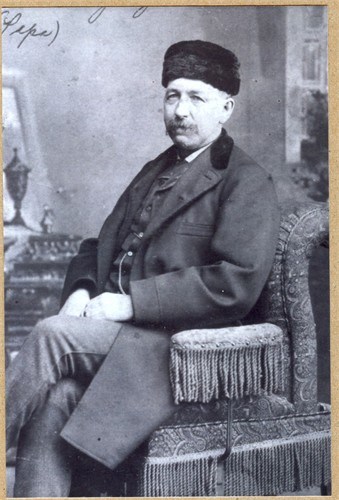
Johan died in 1836. The daguerreotype process was not publicly announced until 1839, and photographic portraiture did not become established in the United States until after Johan was already dead.
The man in the photograph may indeed be another member of the extended Wegley family. He simply cannot be Johan Frederik Weigley.
Johan’s Place in My Family
Johan Frederik belonged to the first generation of this direct family line born and raised entirely on the Pennsylvania frontier. His grandparents had known Germany, his father was born in colonial Pennsylvania, and Johan grew up while the American colonies became an independent nation.
He spent his life in the region his father helped settle, married Catharine, raised at least five children, and watched Brothersvalley change around him. Through his son Joseph William Wegley, his descendants eventually carried the family name far beyond Somerset County.
Johan’s records also preserve the surname’s continuing transformation. Wegerlein became Wagerline, Wagerline increasingly became Weigley, and later generations would carry the name forward as Wegley.