- Born: September 15, 1739, Lancaster County, Pennsylvania
- Died: September 18, 1831, Berlin area, Somerset County, Pennsylvania
- Relationship: My fifth great-grandfather
Philip Wagerline was my fifth great-grandfather and one of the earliest documented European settlers of the Brothersvalley region of Pennsylvania. Born in 1739 to German immigrant parents, Philip spent more than ninety years watching the Pennsylvania frontier change from scattered settlements into established farms, roads, churches, mills, villages, and towns.
His own surname appears in several forms in later records, including Wagerline, Wegerlin, Wegerline, and Weigley. That variation has created considerable confusion in family trees, but the surviving records allow us to follow the same man across more than six decades of Pennsylvania history.
Born in Colonial Pennsylvania
Philip was born on September 15, 1739, in Lancaster County, Pennsylvania, the son of Johann Paul Wegerlin and Ottilia. His parents arrived in Pennsylvania from Germany in 1732 aboard the Johnson Galley, making Philip one of the first in this direct family line to be born in America rather than Europe.
Unlike his older siblings who remembered Germany, Philip grew up entirely in colonial Pennsylvania. He was still a boy during the French and Indian War, became an adult before the American Revolution, and lived long enough to see the United States become an established nation.
The 1765 Deed Connects Philip to His Family
One of the strongest records connecting Philip to the immigrant generation is a deed dated October 3, 1765. The document was created during Philip’s own lifetime and identifies him as Phillip Wegerlin, making it far more valuable than family trees compiled generations later. The deed also connects Philip to his father, Paul Wegerlin, and identifies a larger sibling group than some older versions of my research contained. The family members associated with the deed include Jacob, John, Philip, Adam, Catharine, Ottilia, Ann, and Barbara Wegerlin.
The deed places Philip in Cumberland County, Pennsylvania, in 1765. That does not conflict with later records placing him farther west because county boundaries and jurisdictions changed dramatically during his lifetime.
THIS INDENTURE Made the third day of October in the year of our Lord one thousand seven hundred & sixty five Between George Milin of the County of York in Province of Pennsylvania yeoman of the one part and Jacob Wegerlin Adam Wegerlin of the County of Philadelphia yeoman John Wegerlin Phillip Wegerlin and Nicholas Clay of the County of Cumberland and Catharine his wife Tobias Miller of Lancaster County and Ottilia his wife George Stoll of York County and Ann his wife Jacob Rudesill of Lancaster County & Barbara his wife of the other part WITNESSETH That whereas the said George Milin having obtained a Warrant & survey for a certain tract of land situate in Warwick Township in the said County of Lancaster BEGINNING at a black oak and from thence extending South sixty four degrees East one hundred fifty seven perches to a chestnut thence South thirty five degrees West fifty six perches to a white oak thence South by John Wister’s land seventy eight degrees West eighty eight perches to a chestnut tree thence North eighty five degrees West fifty three perches to a white oak thence North by the said John Wister’s land one hundred perches to a hickory, thence Northwest forty one perches to the place of Beginning CONTAINING eighty nine acres and the allowance as by the return thereof into the Secretarys Office the eight day of June 1743 may appear.
Marriage to Anna Dorothea Fronica Krafft
Philip married Anna Dorothea Fronica Krafft on April 20, 1767. Anna Dorothea was born on October 24, 1748, in what is now Franklin County, Pennsylvania, and died on July 28, 1792, at only forty-three years old. Philip survived her by nearly thirty-nine years. No reliable evidence currently identified shows that he remarried after Anna Dorothea’s death.
Philip and Anna Dorothea had at least five children whose relationships are well supported:
- Susanna Eva Wagerline, 1769-1841
- Johan Frederik Wagerline, 1773-1836
- Catharine Wagerline, 1774-1834
- Philip Wagerline, 1775-1836
- John Wagerline, 1781-1836
Through Johan Frederik, Philip and Anna Dorothea became my direct ancestors. Their descendants eventually carried the surname through forms such as Weigley and, finally, Wegley.
What About Joseph Wagerline?
An older version of my family tree also included a son named Joseph, reportedly born in 1779. Some evidence supports him, but I no longer consider his later life and identity proven enough to place him among Philip’s firmly established children without qualification.
A published transcription of Berlin-area Reformed and Lutheran church records contains an entry for Joseph, born July 4, 1779, son of Philip Waggele. That is meaningful evidence, but the transcription contains inconsistencies, and I have not yet found enough additional evidence to confidently follow Joseph into adulthood.
Philip’s 1830 will names or identifies family connections involving his sons Frederick, Philip, and John, his daughter Susanna, and his son-in-law Peter Glessner. It does not identify a son Joseph.
The 1790 census does not settle the question either. Philip’s household contained four males under sixteen, but even if Joseph is included among Philip’s known sons, the household still included an additional unidentified boy. That person could have been another son, a relative, an apprentice, or someone else living with the family.
For now, I consider Joseph a probable child of Philip Wagerline whose identity requires additional documentation. I would not attach the frequently repeated 1836 death date to him without stronger evidence.
Into Brothersvalley
Philip established himself in the area that became Brothersvalley Township around 1768 or 1769, when he was approximately thirty years old. He was therefore there decades earlier than an old interpretation of the census records led me to believe.
This is where understanding changing county boundaries becomes essential. Brothersvalley was organized in 1771 as part of Bedford County, and Somerset County was not created until 1795.
That means a record saying Philip lived in Bedford County in 1790 does not mean he was living in the town of Bedford, forty miles away. He could have lived on the same Brothersvalley property that later records describe as being in Somerset County.
In other words, Philip did not wait until he was nearly seventy to move to Brothersvalley. Historical evidence places him there around age thirty.
The Man Harmon Husband Encountered
One of the most memorable stories about Philip survives in the early history of Bedford and Somerset Counties. A later county history preserves an account attributed to reformer Harmon Husband, who traveled through the region in June 1771.
According to the account, Husband saw smoke rising from a clearing and eventually encountered a German settler plowing with oxen. The settler was identified as Philip Wagerline, who had reportedly already been living there for about three years.
That would place Philip’s arrival around 1768 or 1769, which fits remarkably well with the broader history of settlement in the region. The Treaty of Fort Stanwix in 1768 had opened additional western Pennsylvania lands to legal European settlement, and families soon began establishing farms in the area.
The story describes Philip speaking German and only broken English, which makes sense for a man raised in a German-speaking immigrant family. It also describes his household as hospitable, providing Husband with food and shelter during his journey.
Who Were All Those Children?
One part of the Husband story deserves caution. The later account describes several children around Philip’s clearing, including boys and girls of various ages and apparently one boy about sixteen.
That cannot be reconciled easily with Philip and Anna Dorothea’s known biological children. In 1771, their daughter Susanna was only about two years old, while Johan Frederik and their other known children had not yet been born.
It is therefore possible that some of the children belonged to relatives, neighbors, workers, or another household. Details may also have become distorted as the story passed through later retellings.
I would not use this passage as evidence that Philip and Anna had a large group of older children before 1771. It is better treated as a colorful historical account whose basic identification of Philip may be sound while some household details remain uncertain.
The Winter That Nearly Drove Him Away
Later local tradition tells another story about Philip’s earliest years in Brothersvalley. According to the account, he built a home, cleared five or six acres, and planted rye before enduring a winter in which deep snow reportedly remained on the ground for months.
The experience was supposedly so miserable that Philip decided to sell his property as soon as spring arrived. He had paid about $50 for the land and would have been satisfied simply to recover his money.
When prospective buyers arrived and offered him $150, Philip was so surprised by the property’s apparent value that he refused to sell. Whether every detail of the story is exact cannot be proven now, but the tradition became part of the early history associated with Philip and the Brothersvalley settlement.
If the story is substantially accurate, one decision changed the family’s history. Philip stayed, and the Wagerline family remained associated with Brothersvalley for generations.
A Farm Called “Pyramid”
Government land records provide much firmer evidence for Philip’s presence in Brothersvalley. On October 5, 1784, Philip received a warrant for land there, and the property was surveyed on December 4 of that year.
The tract was called “Pyramid” and contained approximately 155½ acres, based on a warrant for 147 acres. It was situated along Buffalo Lick Creek in Brothersvalley Township and bordered land associated with several neighboring property owners.
The record identifies the land as being in Bedford County, which was correct in 1784. Again, that does not place Philip in the town of Bedford, because Brothersvalley itself was part of Bedford County until Somerset County was created in 1795.
The 1790 Census
Philip appears in the 1790 United States census in Bedford County, Pennsylvania. His household contained eight people: two males aged sixteen or older, four males under sixteen, and two females.
The two older males were likely Philip and his teenage son Johan Frederik. One of the females was almost certainly Anna Dorothea, while another may have been Catharine.
The younger males cannot all be identified with certainty. Philip Jr. and John fit the household, and Joseph may account for another if the 1779 church record refers to this family, but at least one boy would still remain unidentified.
The census is therefore useful for reconstructing the size of Philip’s household but not for proving the identity of every person living there.
Philip Did Not Move to Brothersvalley in 1800
An older version of my research assumed that because the 1790 census listed Philip under Bedford County and the 1800 census placed him in Brothersvalley, he must have moved between those dates. That conclusion was wrong. The area itself changed counties.
Somerset County was formed from Bedford County in 1795. The same Brothersvalley farm that appeared under Bedford County in 1790 could therefore appear under Somerset County in 1800 without Philip moving anywhere. This is a perfect example of why genealogical research must account for historical boundaries rather than relying only on modern place names.
The 1830 Census Problem
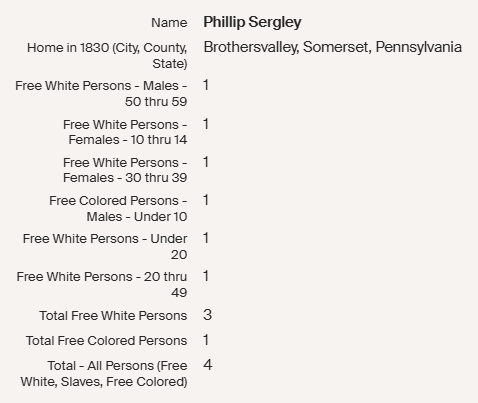
For example, the 1830 US census tells us that Philip was living in Brothers Valley at the time. This is the last US census just before his death in 1981. This means he was about 90 years old at the time. Ages matter because they help us figure out who might have been living with him.
- Anna, his wife (1748) would have been 82 in 1830
- Susanna Eva (1769) would have been 61 in 1830
- Johann Frederick (1773) would have been 57 in 1830
- Catharine (1774) would have been 56 in 1830
- Philip (1775) would have been 55 in 1830
- Joseph (1779) would have been 51 in 1830
- John (1781) would have been 49 in 1830
So that means the 1 adult male who wasn’t Philip could have been Joseph, Philip (the younger), or even Johann Frederick. So this doesn’t really give us enough information. For that, we need to go all the way back to the 1790 US census, when his kids were younger.
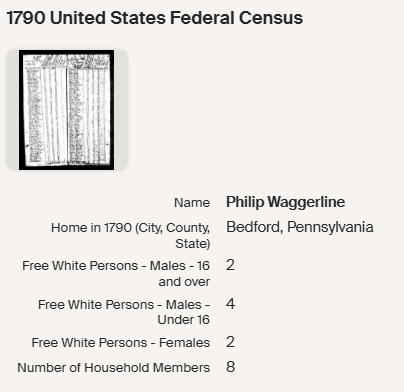
Taking into account all their dates of birth, during this US census, the following family members would have been this old….
- Anna, his wife (1748), would have been 42 in 1790
- Susanna Eva (1769) would have been 21 in 1790
- Johann Frederick (1773) would have been 17 in 1790
- Catharine (1774) would have been 16 in 1790
- Philip (1775) would have been 15 in 1790
- Joseph (1779) would have been 11 in 1790
- John (1781) would have been 9 in 1790
According to this data, there are a total of 8 people in the house.
Another old assumption involved an 1830 census entry indexed as Phillip Sergley in Brothersvalley. I previously assumed it represented the elder Philip shortly before his death.
The age category shows that assumption is almost certainly incorrect.
The household head was a male aged fifty to fifty-nine. Philip the elder was approximately ninety years old in 1830, while his son Philip, born in 1775, was about fifty-five.
The 1830 entry therefore fits Philip Wagerline Jr. extremely well and should not be used to reconstruct the elder Philip’s household. I would remove that census from this page unless it is clearly labeled as belonging to his son.
Wagerline or Weigley?
Another question that confused me for years was why Philip seemed to use Wagerline for most of his life and then suddenly become Weigley in old age. The answer appears to be that he probably didn’t make that change himself.
The 1906 county history specifically says that deeds show the pioneer continued to write his name as Philip Wagerline. More importantly, his own 1830 will identifies him as Philip Wagerline the Eldest.
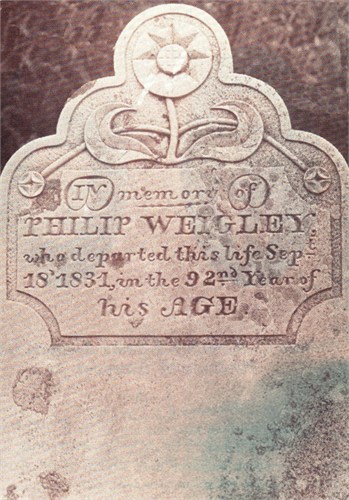
The Weigley spelling became increasingly common among later descendants and in later records. Philip’s gravestone and cemetery transcriptions use Weigley, but that does not prove that Philip himself deliberately adopted that spelling.
The family name was evolving naturally through German pronunciation, English-speaking clerks, church records, census takers, land records, and the preferences of later generations. The family probably never officially changed its name from Wagerline to Weigley.
A digitized book called “Births and baptisms of Somerset Co., Pa. [1777-1856]: Reformed and Lutheran Church records, of Berlin, Somerset County, Pa.” It’s not a perfect transcription. Back then, they didn’t have AI-powered data scanning. But these church records show us that Philip (listed in the book as Philip Waggele) has two sons baptized. Here is a copy of page 37, which is the record I’m referring to.
![Births and baptisms of Somerset Co., Pa. [1777-1856] : Reformed and Lutheran Church records, of Berlin, Somerset County, Pa.](https://www.tracyandfamily.com/wp-content/uploads/ChuchRecords.png)
While the information was transcribed poorly, it still shows that Joseph is a documented child of Philip. But here’s the problem: this poorly transcribed document is the only known record supporting that fact.
We have the US census records from 1790, 1800, 1810, 1820, and 1830 for Philip Wagerline. And as great as that may be, the problem is that it doesn’t give us the kind of information we get today.
“Philip Wagerline the Eldest”
Philip wrote his will on October 23, 1830, less than a year before his death. It is one of the most informative surviving documents from his life. In it, Philip called himself “Philip Wagerline the Eldest.” The wording distinguished him from his adult son Philip, much as we might use “Sr.” and “Jr.” today. He described himself as a yeoman, meaning a farmer or landholding man. By then, the pioneer who had once supposedly considered selling a small clearing for $50 controlled substantial property in Brothersvalley.
What Philip Left to His Family
Philip left his son Philip a plantation of approximately 220 acres. The inheritance required the younger Philip to make substantial payments to other family members, including $600 to John Wagerline, $700 to son-in-law Peter Glessner or his heirs, and $200 to Susanna Markley. His son John received another plantation containing about 116 acres. John also received a much more personal possession: Philip’s eight-day clock.
Frederick Wagerline was allowed to retain proceeds from land he had previously sold to John. Philip also discussed property connected to his deceased son-in-law Joseph Markley, Susanna’s husband. The will shows that the family had already divided, sold, transferred, and reorganized the land before Philip’s death. His estate planning was therefore not simply a matter of dividing one farm equally among his children.
His Mark
At the end of the will, Philip did not sign his name in the conventional way. The surviving transcription records “Philip, his mark, Wagerline.” That does not necessarily mean he could not read or write. Elderly people, people with physical limitations, and even literate individuals sometimes used marks in legal documents, so we should not push the record beyond what it actually tells us.
What it does give us is something directly connected to Philip himself. The legal document was acknowledged as his last will and testament and preserved the mark he made or authorized near the end of his life.
His Death and Gravestone
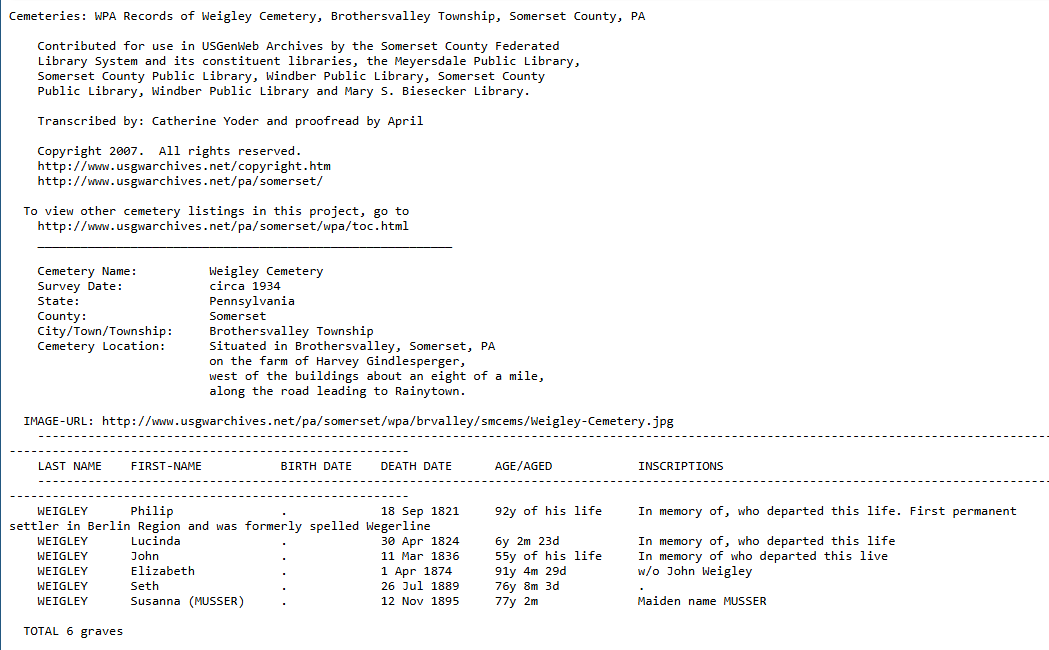
Philip died on September 18, 1831, near Berlin in Somerset County. A twentieth-century WPA survey of the Weigley Cemetery also records his death as September 18, 1831, and describes him as ninety-two years old.
His gravestone reads in part: “In memory of Philip Weigley, who departed this life…”
The stone describes him as being in the ninety-second year of his age. That old-fashioned wording is slightly less precise than a modern statement of completed age, but the family chronology and other research support a birth in 1739 rather than the frequently repeated 1731 date.
The Weigley Cemetery
Philip was buried in the small Weigley Cemetery in Brothersvalley Township, on land later associated with the Harvey Gindlesperger farm. A WPA-era cemetery survey recorded only six surviving graves there.
The survey included Philip, John Weigley, John’s wife Elizabeth, Seth Weigley, Susanna Musser, and another family member whose transcription is incomplete or uncertain. Anna Dorothea does not appear in that surviving WPA list, so although later memorials may place her there, her precise burial location should not be treated as conclusively established.
Philip and the Early History of Brothersvalley
Later county histories repeatedly remembered Philip as one of the earliest settlers of the Brothersvalley region. One account even called him the first known permanent settler in the Berlin area, although I prefer the more cautious wording “one of the earliest documented settlers” because early settlement records are incomplete.
When Harmon Husband reportedly encountered Philip in 1771, the settlement was still extremely sparse. Philip told him that his nearest known neighbor was several miles away and that hunters and trappers still occupied much of the surrounding country.
By the end of Philip’s life, that wilderness had become an established agricultural community. Berlin had been laid out, roads and mills existed, churches served local families, and Philip’s own sons occupied plantations carved from the land their father’s generation had settled.
The Family Joke About the Mill
One of the stories repeatedly preserved about Philip portrays him as something of a practical joker. On a trip east to obtain flour, he reportedly told a miller that he had an excellent mill site on his own property.
When the miller later traveled to Brothersvalley to inspect it, Philip showed him a dry valley beneath a steep hill. Asked where the water was, Philip reportedly replied that the man had asked about a good location and plenty of “fall,” not water.
Whether the conversation survives word for word is impossible to know. The story nevertheless appeared repeatedly in local histories and became part of Philip’s remembered personality.
A Stockade on the Wagerline Farm
Local historical accounts also report that a stockade or blockhouse once stood on land associated with the Wagerline farm. Such defenses were used by frontier families as places of refuge during periods when violence between settlers and Indigenous groups threatened isolated communities.
The surviving account is based on later recollections and traditions rather than a contemporary construction record. It therefore tells us something about how the early Wagerline farm was remembered, but it should not be treated as proof of an event or attack unless additional documentation is found.
Anna Dorothea’s Death
Philip’s wife Anna Dorothea died on July 28, 1792, long before him. She was only forty-three years old, leaving Philip a widower for the final thirty-nine years of his life.
By the time Philip wrote his will in 1830, their children were adults with households, property, and families of their own. The pioneer household established in the late 1760s had become a multigenerational family network spread across Brothersvalley and beyond.
The Strange Year of 1836
Philip did not live to see one of the strangest years in the family’s history. Five years after his death, three of his well-documented sons died during 1836: Johan Frederik, Philip, and John.
There is currently no evidence that the three deaths were caused by a single epidemic, accident, war, or other shared event. Philip Jr.’s gravestone describes a prolonged illness, while the available records do not establish causes for Johan Frederik and John.
I would therefore remove the old claim that four of Philip’s six children died in 1836. The supposed fourth death depends on the still-unresolved Joseph, whose identity and death date are not established strongly enough to count as fact.
Philip’s Place in the Wegley Story
Philip Wagerline’s life bridges the immigrant generation and the Pennsylvania family that followed. His parents crossed the Atlantic, but Philip was born in America and spent most of his adult life helping establish a permanent family presence in Brothersvalley.
The strongest evidence does not show a man who moved to Brothersvalley at seventy or suddenly changed his surname late in life. It shows a man who was there by the late 1760s, acquired and developed land, raised a family, accumulated substantial property, and continued calling himself Philip Wagerline into his final year.
He died on September 18, 1831, after more than sixty years connected to the Brothersvalley region. By then, the small frontier clearing associated with his early life had become the foundation of generations of Wagerlines, Weigleys, and eventually Wegleys.
The Somerset County Historical Society produced a 1945 publication called a Somerset County Historical Notebook, compiled from Mary Hause’s newspaper columns.
Old Mr. Philip Weigley must have been among the earliest settlers, perhaps the next after Rhoads. He came to Brothersvalley, built a house, cleared five or six acres of land and sowed it in. Rye.
The next winter the snow was five to seven feet deep and lay without a thaw for nearly four months. He concluded that the climate would be intolerable and that he would take for his land what he could get so that he might get off as soon as possible in the spring. He had paid $50 for it, and he thought if he could get that much he would be a fortunate man.
Soon after the spring opened, three persons came along exploring the country for a place to locate themselves, and seeing his field of rye, which was a remarkably promising crop, they asked him what he would take for his place. He was afraid to put his price of $50 upon it lest it might frighten them, and he therefore told them to make him an offer. They offered him $150, and it astonished him so much that he broke the negotiation short and told them he would not sell.
On July 1, 1954, The Daily American produced a story (on page 38). It tells the story of Mr. Husband, as mentioned above.
HUSBAND IS FIRST MAN IN SOMERSET: By VERA R. BARBER
The story of the [unclear] circumstances that Harmon Husband, the colorful “Old Quaker,” found his way into this part of Pennsylvania. But these circumstances compose an interesting and [unclear] story.
For family history and background of Harmon Husband is somewhat obscure, it is known, however, that his maternal great-grandfather, Thomas Kinsey, migrated from Germany and had settled in Newcastle County, Md., as early as 1694. His [maternal family] and his father, William Husband, were married May 20, 1721, and four years later, October 3, 1724, Harmon was born.
For some reason not quite clear, he left the parental home at the age of six to live with his grandfather, Herman Kinsey, in order that he might obtain some schooling. He was impressed with his grandfather’s standing among his neighbors where he was known as a “good old man,” and he soon learned the same qualities of goodness expected of him. This goodness was based on a religious belief tending strongly with the tenets of John Calvin.
MAN OF EDUCATION
He remained in his grandfather’s home for two years until the latter’s death when the lad returned to his family. What further education he acquired is a matter of conjecture, but he became a man of education above the level of those he associated with. He had a superior mind capable of grappling with fundamental ideas and he developed a taste for serious reading.
During the years spent with his grandfather Kinsey, he was greatly influenced by religion of the stern Calvinistic type, so as he grew to manhood he more and more looked with disfavor on all worldly pleasure, and one by one he renounced them. While severe with himself, he was kind and generous with others.
His deep religious feeling and his desire for knowledge brought him in touch with books from the Benjamin Franklin Press in Philadelphia. Finally a history of the Quakers fell into his hands in which he found truth in plain character. He continued his study of the “plain people” and eventually he identified himself outright as a Quaker.
The Husband family, of which Harmon was a member, grew and prospered and one by one each of the children married and established homes of their own.
Of Harmon’s first marriage, little is known. There is no record of his wife’s name and it is believed that she did not live long. Records reveal, however, that she left three children with the young father of [about 23] years of age to look after them. In turn his mother helped.
During the next few years he made several trips. One was to the West Indies and a year or so later he made a trip into North Carolina with an enterprising group from Lancaster County, Pennsylvania. Having left his children in the care of their grandmother, he did not become identified with this group, but returned to his Maryland home. However, several years later he returned to North Carolina and acquired much property during the four years he spent there.
SOLD PROPERTY
His return to Maryland seems to have been something of a farewell visit for he spent the next few years selling his property and closing out all business before taking his motherless children to the southern frontier. The year following his return he married Mary Pugh in July 1762. By this time he was proprietor of a “lordly domain” in the Sandy Creek section of North Carolina.
Three and a half years later [his wife died], leaving two more children. Shortly after this he fell into dispute with the Quakers for some critical remarks he had made and while he remained a Quaker at heart and in his way of living, there is no record of his ever again being formally identified with them.
Again May 30, 1764, Harmon Husband married Amy Allen, who had [unclear] and cheered him along the rest of his tumultuous life. He kept in touch with happenings of the outside world by books and pamphlets which came to him regularly from Philadelphia.
Although the Revolutionary War was still in the future, already there were rumblings of dissatisfaction against the British, and a tax of any kind imposed by the crown. And so it was from his Philadelphia “mail” that he learned of the proposed Stamp Act and the spirited opposition to it in the coastal towns. It had long been accepted as law that only the Assembly, composed theoretically of the people’s representatives, had power to raise revenue.
So while Harmon Husband was far removed from the scenes of action, he was nevertheless interested. He reasoned that the trouble lay with the Assembly, since elections were managed by the crown. To this deeply religious Quaker this was a matter of principle so it is easy to see how he became embroiled in a “fight for right.” And because of his better education, his broader knowledge of events and his natural ability to influence men, he became one of the leaders in the cause of justice and liberty.
CRUEL YEARS
Then followed cruel years, with false accusations, arrests, imprisonment and even threat of death but always “this good man” departed himself ably and well and in each case was found free from actual wrong-doing.
Came an election, and Husband was elected Assemblyman from his county. However, realizing his uncertain standing, he set about disposing of his property, deeding it to friends and relatives, so that it could not be confiscated.
His duties as Assemblyman were frustrating and led to new charges against him and a new confinement in jail, but again appearing before a grand jury, they could bring no charges against him.
The climax was reached in the Battle of Alamance. But even before the governor had begun his march to the Great Alamance camp, Harmon Husband had fled upon the knowledge of friends that a posse was searching for him.
Reaching the home of a friend he changed his Quaker garb for more worn and travel-stained clothes, and his fine horse for a sorry one, and thus it was he finally reached what is known as Somerset County. But first he visited his brothers and sisters in Maryland.
BEYOND THE MOUNTAINS
Harmon Husband did not linger in Maryland because his brothers and sisters were apprehensive that danger would follow him into so likely a retreat. In planning for his safety they recalled that an old friend and neighbor, Isaac Cox, was on a hunting and trapping expedition somewhere beyond the mountains.
Mounting his old horse, he started out in search of Cox’s camp. Although ordinarily a man who made a record of his impressions and happenings, there seems to be no word of this particular journey.
It is known that he crossed the Allegheny Mountains June 1771, near what is now Sand Patch and seeing smoke in the distance he traveled toward it, coming to the home of Philip Wegerline (now Wegley) where he introduced himself as “Tuscape Death.” There he remained for the night, starting again on his search next morning.
The second night in the wilderness overtook him with still no sign of his friend’s camp. As night fell a summer storm broke and having come upon a cabin which was unoccupied, he decided to spend the night. Before long, however, the owner returned and welcomed the intruder.
As it turned out the owner, William Sparks, had just returned from spending a night with Isaac Cox, but the latter had left for a week’s absence. So “Tuscape,” on invitation, spent the following week with Sparks.
It was from the Sparks’ cabin that Harmon Husband made his first [unclear] explorations. From his journal, some of the following winter there is written possibly during the lonely vigilance of his [unclear] speculation of the natural beauty he had found in his new surroundings and of the place it brought him.
During that first summer his friends could but wonder about this strange, silent man who spent his time studying the countryside, charting streams and roaming quite fearlessly, [unclear] through the woods, where wild animals abounded and where Indians were not unknown. Thus he became known as the “Old Quaker.”
ACQUIRED GROUND
That same summer he acquired his first piece of ground and prepared to establish a permanent home. And when autumn came, and the hunters and trappers returned to their homes, Harmon Husband was left quite alone in the wilderness.
Spring brought news from his family who were now living in Hagerstown, Maryland. So the head of the Husband family set about building a home and raising some crops. And by fall he was ready to start into Maryland for the purpose of returning with his family to their new home.
He found the family willing and ready to make the trip. As they penetrated deeper and deeper into the lonesome and unfamiliar country, it must, indeed, have tested the stout heart of “Amy.” But she found a new log house, with its spacious rooms and fireplaces awaiting her and she immediately set about turning the house into a home for her husband and her family.
[Now] surrounded by his sons and daughters, he dropped his assumed name. So he once more became known as Harmon Husband.
The Revolutionary War seems not to have greatly affected the Husband family. However, Harmon pursued his way, increasing his holdings, his knowledge of affairs and his influence. As ever he kept in touch with the outside world. And in any wrong that needed to be made right, Harmon Husband could be depended upon to champion the cause.
For the next decade the colonies were busy setting up the federal government and their own state governments.
But in 1791, by an act of Congress, an excise tax was levied on distilled liquor. Bedford County, of which Somerset County was still a part, abounded in distilleries. The chief crop of these frontiersmen was grain. To send these crops across the mountains was impracticable, with roads as they were in that day. Crops would not bring in Philadelphia the cost of the transportation.
Use of the Ohio River for transporting the crops was yet unknown. But to distill the grain and then ship it to the east in small packages was, indeed, good and profitable business.
The agitation which arose over what was considered an unfair tax led directly to Harmon Husband, although he was not one of the leaders. But such was his reputation. The government made some concessions but still “the agitators would not be quieted.”
Finally it was decided to call a meeting of dissatisfied districts for August 1794 at Parkinson’s Ferry. To this meeting Harmon Husband was delegated to go. The outgrowth of the meeting, at which Albert Gallatin served as chairman, was to establish a standing committee to confer with state and federal authorities, and again the “Old Quaker” was selected to serve.
So far as is definitely known, attendance at these two meetings constitutes Harmon’s only activity with the Whiskey Rebellion, but it nevertheless led eventually to his arrest.
Although Thomas Jefferson referred to the Whiskey Rebellion as “an insurrection, that was announced and proclaimed and armed against, but which never could be found,” still news of the rebellion grew until finally two divisions of troops were sent into Bedford County, one passing through Uniontown and the other passing along the Forbes Road which is now the Lincoln Highway.
This latter division had instructions to arrest Harmon Husband and General Robert Philson, who lived near the present site of Berlin.
It seems that Gen. Philson, an influential and prominent man, had set up in front of his home, in defiance of the government, a liberty pole bearing the slogan “Liberty and No Excise Tax.” He is reported to have talked a great deal against the government and is supposed to have helped Harmon Husband to erect a similar pole on the diamond in Brothers Valley.
They were arrested and taken to Bedford for a hearing. From Bedford [Husband was taken east]. His wife followed.
It have just little to tell you now that we who are prisoners here are in the fort in Philadelphia, [unclear] to be in favor of the rights and will set up a Liberty pole [unclear].
[The remaining lines are badly degraded.]
He was buried on the [unclear] of June in 1795, but his final resting place is unknown.
In 1961, the Pittsylvania Notebook wrote a story featuring Philip. It was called The Empty Mill Pond, written by George Swetnam (The Pittsburgh Press, Sunday, June 11, 1961).
NOBODY knows who the victim of the joke was. It may have been Michael Troyer, one of the first to build a mill in the area near Berlin, in Somerset County.
The man who pulled it was Philip Wagerline, one of the first to settle in the area, and one of the famous practical jokers of the Pittsylvania Country.
Wagerline was already settled in the area when Harmon Husband came through Brothers Valley on June 5, 1771, fleeing from a death penalty for opposing tyranny in North Carolina. He mentions that the German had a large family of children, and spoke only broken English.
But later on, Wagerline’s English became more fluent, and he could talk well enough to get the laugh on almost anyone. Even when serious matters were involved, he was likely to be found pulling somebody’s leg.
For nearly a decade after settlers came into the area, there were no mills. The only flour to be had was by going 30 miles or more to Cumberland or Bedford, a long, slow trip for that day, over mountains and through a howling wilderness.
Wagerline wanted to interest someone in building a mill in the valley, and on one of his trips eastward for flour, he gave the miller such a glowing account of the district that the latter asked him if there were no mill sites in Brothers Valley.
“Yes,” said Wagerline. “I have a good one on my own land.”
“What fall would I be able to get?” asked the miller.
“Any fall you please,” said Wagerline.
“I am bound to come out and see you,” declared the miller, “and if you can show me such a situation, I will build you a mill.”
In due time, the miller came across the mountain ridge to Wagerline’s home, and was given a cordial welcome. Next day he was all agog to be taken to see the wonderful mill site.
There were plenty of good ones available in the district, but instead of taking his visitor to any of them, Wagerline took him to a dry valley, flanked by high, steep cliffs.
Pointing out a level spot, he beamed at his visitor, and asked: “Would you want a nicer place for a mill?”
The miller stood aghast for a moment. “But where is the water?” he asked.
“Water,” said Wagerline, with a straight face. “You said nothing about water. All you spoke of was a situation and a fall, and here you can have all the fall you need.”
In 1976, the Daily American produced a bicentennial edition of its newspaper, running a story called “Early Settlers” that mentions Philip as it recounts the Husband story.
EARLY SETTLERS
Very little is written of the earliest white men to enter the territory that later became Somerset County. Indians, mainly of the Delaware tribe, were here when the white people arrived, and needless to say, were not pleased at the thought of losing their hunting grounds. One of the first white men to settle in what is now Somerset County was George Dibert. Dibert and his family settled on a small tract of land about a mile from the present town of Berlin. The land was purchased under the Tomahawk claim of 1753, and was part of the farm now owned by John Stoner.
It is said that Dibert was burning stumps at the edge of his clearing one day when he heard his wife screaming and the children crying. He heard a shot and saw his oldest son fall, and then from the bushes he witnessed two Indians dragging his wife from the cabin by her hair. The Indians scalped her as she struggled and afterwards gave her a mercy blow from a tomahawk. George Dibert saw his entire family scalped as he hid in the brush. Dibert escaped by making a huge circle around his land during the nights and hiding in the laurel thickets for three days. Returning to the cabins he then managed to drag his family into a shallow ditch during the night and cover the bodies with stones and brush. Traveling on foot, Dibert walked over the mountains 139 miles to Carlisle, where he told his tragic story.
Christopher Gist
The first white surveyor sent to the area was probably Christopher Gist. He was sent out in 1749 by the Ohio Company to explore and report on the land of the Ohio Valley. Gist and his party traveled over the Nemacolin’s Trail through what is now Addison Township. He crossed the Youghiogheny River at what later became known as the “Great Crossings” near the now inundated town of Somerfield.
The following year 1750, Gist again traveled through the county over the old Northern Indian Trail that was in Shade, Quemahoning and Jenner Townships. He left a very complete journal, and tells of reaching the Stony Creek on Friday evening, November 9, 1750. A heavy rain was falling and they took shelter in an old abandoned Indian lean-to. On Sunday morning they resumed their journey. The party passed through Kickenipawlings (an Indian village) the site of which is now covered by the Quemahoning Reservoir. In 1752 Gist built a cabin and persuaded eleven families to settle around him. Gist being a surveyor was very familiar with the area.
John Miller
Another early settler was John Miller. Records from a Moravian missionary show that Miller was living in the area in 1762. The missionary, from Lititz, Lancaster County, was passing through on March 30 of that year when a heavy snow storm hit. He found the cabin of Miller and visited while the snow stood at three and a half feet deep. Miller, who was a pack horse driver with Colonel Bouquet’s forces in 1758 was living near Fort Dewart on the headwaters of Breast-work Run in what is now the county. Miller’s sons guarded the horses against wolves because they had no barn in which to protect them. He is mentioned in Harmon Husband’s records of the early settlers near the top of Allegheny Mountain.
Harmon Husband
Harmon Husband, a relative of Benjamin Franklin, was another of the first settlers. Husband was born and raised in the state of Maryland. He moved his family to North Carolina where he held large estates and was a prominent man in his community. He was a Quaker preacher and a member of the North Carolina assembly.
At that time King George was imposing heavy taxes on all of the colonists. From Husband’s pulpit came weekly denouncements of the King, Governor and all the despots who tried to make the new world a gold mine with which to keep the court in splendor. Husband organized a group of “Regulators.” They armed themselves and on May 16, 1771 met the king’s army along the Alamance River where they suffered terrible defeat. Husband would not defend himself.
He rode from the battlegrounds and was not seen again in North Carolina until after it had won freedom from British rule. Leaving his family at the mercy of neighbors and friends, Husband rode northward and searched for a boyhood friend whom he knew was a trapper in this area. To escape being traced by the King’s men, he changed his name to “Tuscape Death,” and the settlers in Brunerstown (now Somerset) knew him by this and a later alias, “The Old Quaker.”
While Husband was searching for his friend, Isaac Cox, he left the Braddock Road at Cumberland and was following Wills Creek. On June 6, 1771, he came to the top of Allegheny Mountain about noon and noticed a column of smoke rising from a clearing.
Towards evening he and his weary horse, Tom, entered the clearing and saw a man engaged in plowing with a team of oxen. A number of children were chopping, grubbing and burning brush. As he approached the clearing, a dog gave the alarm. The man stopped his team and gazed in surprise as he recognized a white man instead of an Indian.
The children all ran into the cabin, excepting the oldest boy who ran to his father’s side. As the traveler came closer, the man waved a salute. The hand of friendship was extended and eagerly grasped by Husband. Philip Wegerline spoke in German, but seeing his visitor didn’t understand, switched to broken English and said, “Welcome, Brother, where you come?”
The men continued their conversation, and Wegerline told his son to unhitch the oxen. Turning to his cabin, he said, “Come along, you be hungry, you be tired.” Husband readily followed and was introduced to the frightened mother and children. The horse was unloaded and turned loose to graze in the glade. Wegerline’s wife began preparing food. After they had eaten, he spent the night under a friendly roof with the Wegerline family.
In the morning his host spoke to his wife and left with his gun. A half-hour later a shot was heard, and the family and guest stepped outside to dress the deer. Breakfast was a plain substantial meal of venison, boiled rye, boiled potatoes, and salt. Wegerline urged his guest to settle nearby since their closest neighbor was six or seven miles away. Husband explained that he was looking for his friend Cox, and after a day’s rest, he again took up his search.
Michael Buechele
Another of the earliest settlers with a very interesting background was Michael Joshua Buechele. He came to this area in 1772. Michael was the son of a German nobleman and his Morgannic wife. Because his mother was of inferior rank, his father could not claim his castle until he got rid of his wife and children. He sent Michael and his mother to America.
Soon after they reached this country, she received word that she too had fallen heir to a large fortune in Germany but would have to return with her child to claim it. At this time, ocean travel was very hazardous and dangerous. They pondered the situation for a while and, finally making up her mind, they started the journey back to Germany. In the year 1751 or 52. Pirates boarded the ship they were traveling on.
Pirates Kill Mother
Michael’s mother was killed, and Michael was taken captive. He was about 12 or 13 years old at the time, and remained a captive of the pirates for about two years. While the ship was anchored in Philadelphia harbor, he escaped and made his way to Germantown, where he was reared by a German Family. In the year 1762, he married [Barro Inken?], who was born and raised in Bucks County, Pennsylvania. They had three sons: John, Jacob, and Joseph.
As rumors of the war between England and the thirteen colonies began to appear, Michael decided to take his family inland. He was Amish and opposed to bearing arms. With his wife and sons on the back of the horse he led, Michael set out in 1772. They crossed the mountains to mid-state and finally reached Somerset County near where Pine Hill is now located. Michael Buechele had a large landholding and is the ancestor of the Buechley clan in Somerset County today. Over the years, the German spelling Buechele has been converted into many English versions.